A single spawning can be anything from 100 to over 1,000 eggs, so most keepers raise only some of them. Water temperature is the main thing that sets the date.
| Incubation period | About 14 days at About 68°F (20°C) |
|---|---|
| Usual hatch window | Day 12 to day 17 |
| Eggs per spawning | 100 to over 1,000 |
| Maximum water temperature | 25°C (77°F) |
| First food | Newly hatched brine shrimp |
How to use the axolotl egg incubation calculator
- Enter the day the eggs were laid in the date box.
- Pick the water temperature: About 64°F (18°C), About 68°F (20°C), About 72°F (22°C).
- Read the hatch date, with the earliest and latest usual dates and where you are today.
- Use the timeline to see the next step.
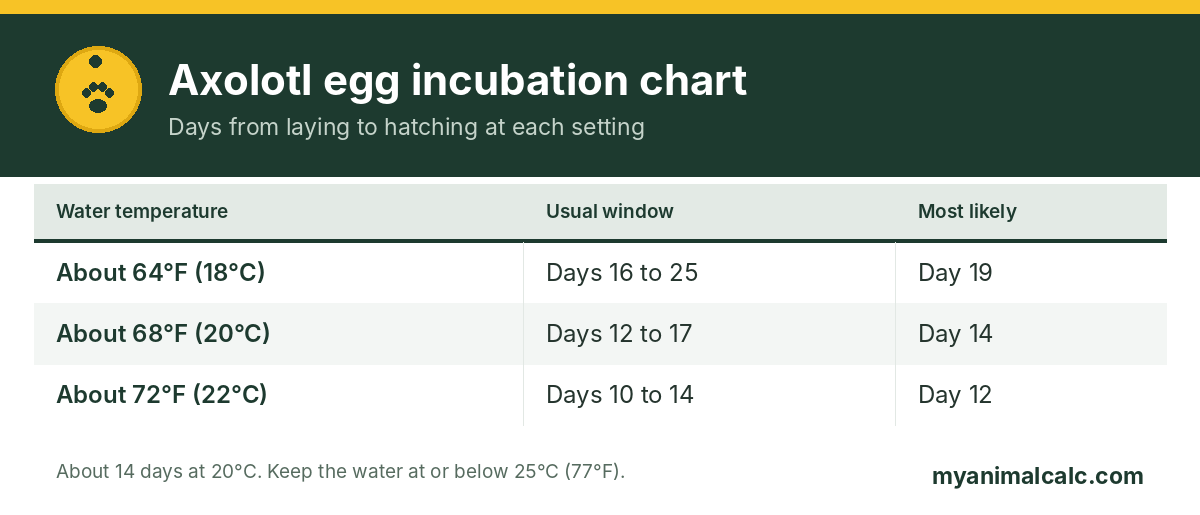
Axolotl egg incubation chart
Days from laying to hatching at each setting.
| Water temperature | Usual window | Most likely |
|---|---|---|
| About 64°F (18°C) | Days 16 to 25 | Day 19 |
| About 68°F (20°C) | Days 12 to 17 | Day 14 |
| About 72°F (22°C) | Days 10 to 14 | Day 12 |
The axolotl egg incubation calculator above turns these figures into calendar dates.
How long do axolotl eggs take to hatch?
The San Diego Zoo Wildlife Alliance fact sheet gives about 2 weeks at 20°C, adding that eggs may take up to 3 to 4 weeks depending on water temperature and other conditions. Keeping the water warmer, but never above 25°C (77°F), gets hatching under 14 days, and cooler water around 18°C slows it down.
The calculator uses day 14 at 20°C, about day 12 at 22°C and about day 19 at 18°C, with a window either side.
Looking after axolotl eggs and larvae
- Keep the eggs in dechlorinated, aerated water and remove any that turn white or furry.
- Do not crowd them: a research colony keeps no more than about 75 embryos in a 1.5 litre bowl.
- Remove unhatched eggs and empty capsules after the hatch, as they can block the larvae’s guts.
- Start newly hatched brine shrimp when the larvae begin to gulp air bubbles at the surface.
Why the hatch date is a window
Eggs in the same clutch rarely all hatch on one day, and a degree or two of difference in the water moves the whole clutch by days. Start checking daily from the earliest date and keep conditions steady. Do not open or throw away eggs that still look healthy until the latest date has passed.
Printable axolotl egg incubation chart
The chart above as an image, to save on your phone or print. Use the axolotl egg incubation calculator at the top of the page for any other date.
For egg-laying fish, see the goldfish egg hatching calculator; for reptiles, the red-eared slider egg incubation calculator.
Axolotl egg incubation calculator FAQs
How long do axolotl eggs take to hatch?
About 2 weeks at 20°C (68°F), up to 3 to 4 weeks in cool water.
How can I make axolotl eggs hatch faster?
Warmer water speeds them up, but keep it at or below 25°C (77°F).
How many eggs do axolotls lay?
From about 100 to over 1,000 in one spawning.
When do baby axolotls start eating?
When the larvae start gulping air at the surface; offer newly hatched brine shrimp.