Farmed deer are usually managed as a herd, so enter the days the stag was in as a date range.
| White-tailed and mule deer | About 200 days |
|---|---|
| Fallow deer | About 230 days (225 to 237) |
| Red deer | 233 to 234 days (228 to 243) |
| Elk (wapiti) | About 250 days (247 to 262) |
| Variation | Up to about a week either way in farmed deer |
| Young | Usually one; twins common in white-tailed deer |
How to use the deer gestation calculator
- Pick how to count: One date for a single breeding, Range if the buck or stag was with her for several days, or Plan ahead to work back from the date you want the fawn.
- Enter the date and the species.
- Read the fawning date with the earliest and latest normal dates, the week of the pregnancy and the days left.
- Check the timeline for late-pregnancy feeding, each with its own date.
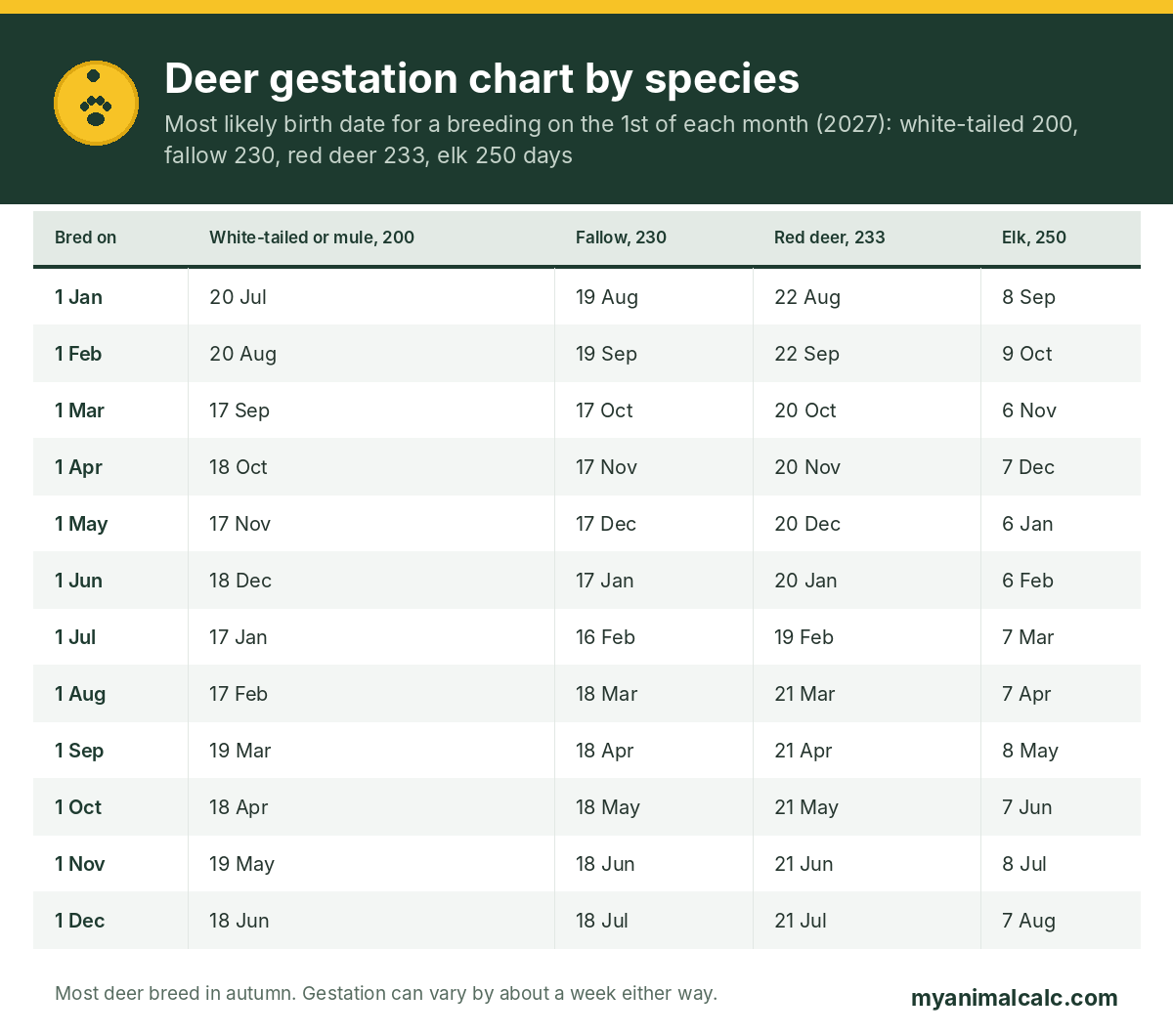
Deer gestation chart by species
Most likely fawning or calving dates for a breeding on the first of each month in 2027, by species. A date earlier in the year than the breeding date falls in the following year.
| Bred on | White-tailed or mule, 200 | Fallow, 230 | Red deer, 233 | Elk, 250 |
|---|---|---|---|---|
| 1 Jan | 20 Jul | 19 Aug | 22 Aug | 8 Sep |
| 1 Feb | 20 Aug | 19 Sep | 22 Sep | 9 Oct |
| 1 Mar | 17 Sep | 17 Oct | 20 Oct | 6 Nov |
| 1 Apr | 18 Oct | 17 Nov | 20 Nov | 7 Dec |
| 1 May | 17 Nov | 17 Dec | 20 Dec | 6 Jan |
| 1 Jun | 18 Dec | 17 Jan | 20 Jan | 6 Feb |
| 1 Jul | 17 Jan | 16 Feb | 19 Feb | 7 Mar |
| 1 Aug | 17 Feb | 18 Mar | 21 Mar | 7 Apr |
| 1 Sep | 19 Mar | 18 Apr | 21 Apr | 8 May |
| 1 Oct | 18 Apr | 18 May | 21 May | 7 Jun |
| 1 Nov | 19 May | 18 Jun | 21 Jun | 8 Jul |
| 1 Dec | 18 Jun | 18 Jul | 21 Jul | 7 Aug |
Wild deer breed in autumn, so the autumn rows match real fawning dates. The deer gestation calculator above works out any date.
How long are deer pregnant?
White-tailed deer carry for about 200 days, according to the Virginia Department of Wildlife Resources, and MSD gives the same figure for mule deer. Red deer average 233 to 234 days (Deer Industry New Zealand); research by Graham Asher found adult hinds ranged from 228 to 243 days, while first-time hinds varied far more. Fallow deer average about 230 days, with 225 to 237 reported, and elk about 250, with FAO giving 249 to 262.
The Deer Industry Association of Australia notes that any of these can vary by up to a week, and hinds that conceive early in the season tend to carry a little longer, so births bunch together.
Back-dating the rut from a fawn
Wildlife biologists use the gestation length in reverse: a white-tailed fawn born on 1 June was conceived about 200 days earlier, around mid-November. Choose Plan ahead, enter the date a fawn was born and pick the species to see when its mother was bred. Spotting newborn fawns over a few weeks gives you the peak of the local rut.
Printable deer gestation chart
The chart above as an image, to save on your phone or print. Use the deer gestation calculator at the top of the page for any other date.
Check a deer’s age with the deer years to human years calculator. For reindeer, use the reindeer gestation calculator.
Deer gestation calculator FAQs
How long is a deer pregnant?
About 200 days for white-tailed and mule deer, 230 for fallow deer, 233 for red deer and 250 for elk.
When do white-tailed deer have fawns?
About 200 days after the rut, so does bred in November fawn in late May and June.
Can I work out when a doe was bred from a fawn?
Yes. Count back about 200 days for a white-tailed fawn; the calculator’s Plan ahead mode does this.
How long are elk pregnant?
About 250 days, or a little over 8 months; FAO gives 249 to 262 days.
Sources
- Virginia Department of Wildlife Resources: Fawning dates are key to rut timing
- MSD Veterinary Manual: Approximate gestation periods
- Deer Industry New Zealand: Annual cycle of hinds
- Asher GW (AgResearch): Gestation length in red deer, genetically determined or environmentally controlled?
- Deer Industry Association of Australia: Deer Farmers’ Handbook, reproduction
- Deer Industry Association of Australia: Comparison of farmed deer species
- FAO: Biology of farmed deer species