Pick Muscovy for that breed; Pekins, Runners, Khaki Campbells and other ducks descended from the mallard all take 28 days.
| Incubation period | 28 days (Muscovy 35) |
|---|---|
| Usual hatch window | Day 27 to day 29 |
| Lockdown | Day 25 |
| Temperature | 100°F (37.8°C) (forced air) |
| Humidity | 85–86°F wet bulb (about 55% RH) |
| At hatch | 90°F wet bulb (about 65 to 70% RH) |
| Candling | day 10 and day 21 |
How to use the duck egg incubation calculator
- Enter the day the eggs were set, the day they went into the incubator or under a broody hen.
- Choose your incubator: forced air (with a fan) or still air, which runs a little warmer.
- Read the hatch date, the lockdown date and today’s day of incubation.
- Or plan ahead: enter the date you want the ducklings and see when to set the eggs.
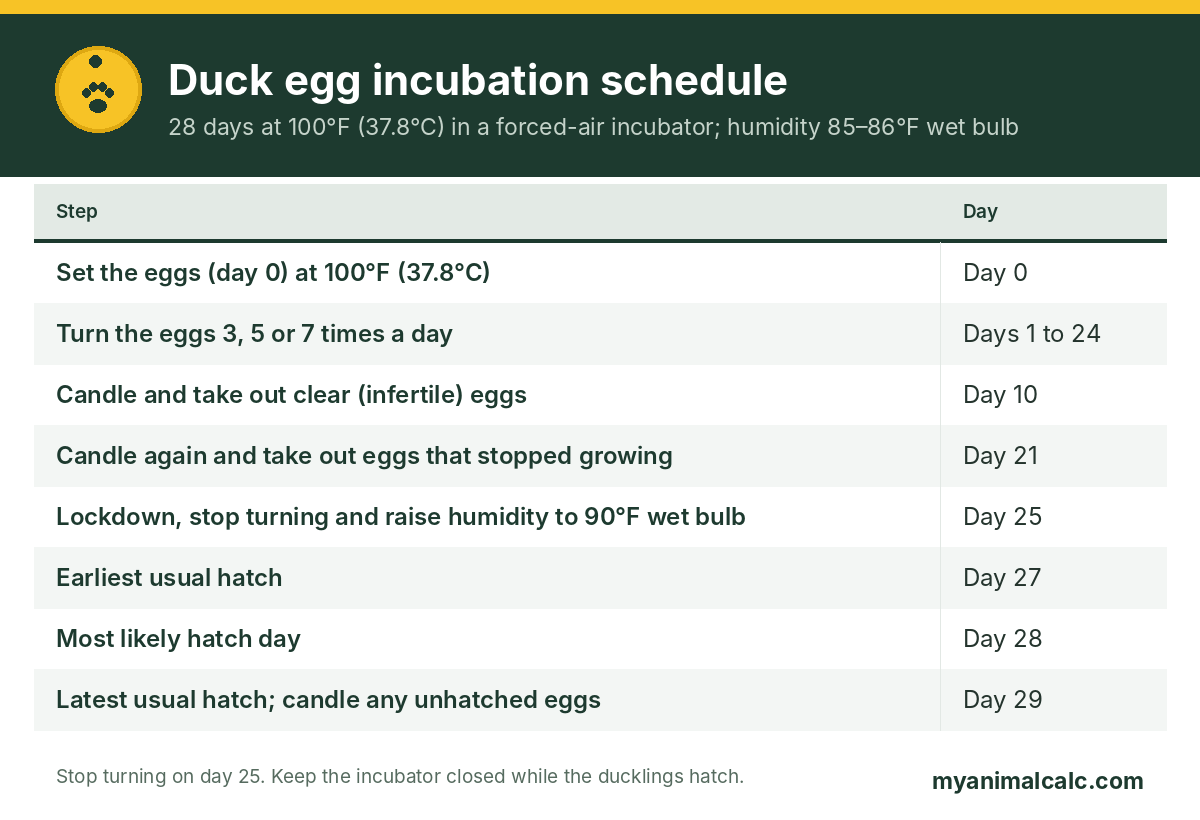
Duck egg incubation schedule
Each step in days from setting, for a 28-day incubation (most ducks; Muscovy eggs take 35 days and lock down on day 31).
| Step | Day |
|---|---|
| Set the eggs (day 0) at 100°F (37.8°C) | Day 0 |
| Turn the eggs 3, 5 or 7 times a day | Days 1 to 24 |
| Candle and take out clear (infertile) eggs | Day 10 |
| Candle again and take out eggs that stopped growing | Day 21 |
| Lockdown, stop turning and raise humidity to 90°F wet bulb | Day 25 |
| Earliest usual hatch | Day 27 |
| Most likely hatch day | Day 28 |
| Latest usual hatch; candle any unhatched eggs | Day 29 |
The duck egg incubation calculator above turns these days into calendar dates for your eggs.
How long do duck eggs take to hatch?
28 days for most ducks, according to MSD, Mississippi State and the University of Kentucky. Muscovy ducks are a different species, and their eggs take 35 days (MSD) or 35 to 37 (Mississippi State). Mississippi State’s guide stops turning duck eggs on day 25, and Muscovy eggs on day 31.
| Breed | Days | Lockdown |
|---|---|---|
| Pekin, Runner, Khaki Campbell, Rouen and most ducks | 28 | Day 25 |
| Muscovy | 35 (35 to 37) | Day 31 |
Temperature, humidity and turning
Mississippi State University Extension recommends 100°F (37.8°C) in a forced-air incubator and a wet-bulb reading of 85–86°F wet bulb until lockdown, rising to about 90°F wet bulb for the hatch. Still-air incubators (no fan) need 2 to 3°F more, measured at the top of the eggs. The wet-bulb figures convert to the relative humidity shown in brackets at incubator temperature.
- Turn the eggs an odd number of times a day (3, 5 or 7) so they spend alternate nights on each side, or use an automatic turner.
- Stop turning on day 25, about 3 days before the hatch, so the ducklings can get into position to pip.
- Keep the incubator closed during the hatch; opening it lets the humidity fall.
Candling duck eggs
Duck eggs have thicker shells than chicken eggs, and the University of California notes that turkey, duck and goose eggs are candled later because of their longer incubation. Candle at about day 10 to remove clears, and again around day 21, before lockdown. MSD advises candling at least once, after the first peak of early embryo deaths at 7 to 10 days.
Printable duck egg incubation chart
The chart above as an image, to save on your phone or print. Use the duck egg incubation calculator at the top of the page for any other date.
For other waterfowl, use the goose egg incubation calculator; for chickens, the chicken egg incubation calculator. Check an older duck’s age with the duck years to human years calculator.
Duck egg incubation calculator FAQs
How long do duck eggs take to hatch?
28 days for most ducks, and about 35 days for Muscovy ducks.
When is lockdown for duck eggs?
Day 25 for most ducks and day 31 for Muscovies, according to Mississippi State University Extension.
What temperature do duck eggs need?
100°F (37.8°C) in a forced-air incubator, or 2 to 3°F higher in a still-air incubator.
Why do Muscovy eggs take longer?
Muscovies are a different species from mallard-derived ducks, and their eggs need 35 to 37 days.
Sources
- MSD Veterinary Manual: Approximate incubation periods
- Mississippi State University Extension: Hatchery management guide for game bird and small poultry flock owners
- University of Kentucky (ASC-195): Development of the chick, incubation periods of poultry
- University of California ANR (Publication 8134): Candling and breakout analysis of hatching eggs
- MSD Veterinary Manual: Laying and reproduction in backyard poultry