Cats are long-day breeders, so under natural light most stop cycling in late autumn and early winter, while indoor cats under electric light may cycle all year.
| Heat lasts | About 6 days (3 to 16) |
|---|---|
| Not mated | Next heat in about 2 to 3 weeks |
| Mated, not pregnant | Next heat in about 7 to 11 weeks |
| Breeding season | Long days; January to mid-October in the north |
| Year-round cycling | With 12 to 14 hours of light a day |
| First heat | 4 to 12 months, about 6 on average |
How to use the cat heat cycle calculator
- Enter the first day of her last heat, the day the calling and rolling started.
- Say whether she was mated during that heat; mating makes her ovulate, which delays the next heat.
- Choose her daylight: indoors with long hours of light, or natural daylight in the northern or southern hemisphere.
- Read the window for her next heat and the next few after it.
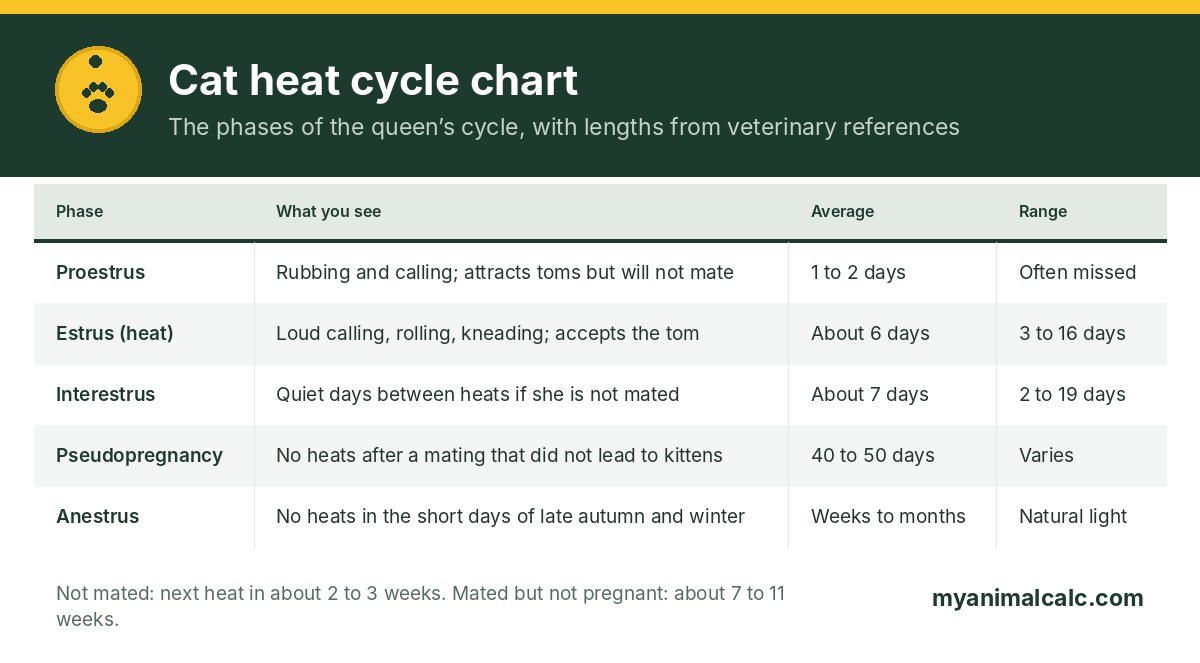
Cat heat cycle chart by phase
The phases of a queen’s cycle, with the lengths reported in veterinary references.
| Phase | What you see | Average | Range |
|---|---|---|---|
| Proestrus | Rubbing and calling; attracts toms but will not mate | 1 to 2 days | Often missed |
| Estrus (heat) | Loud calling, rolling, kneading; accepts the tom | About 6 days | 3 to 16 days |
| Interestrus | Quiet days between heats if she is not mated | About 7 days | 2 to 19 days |
| Pseudopregnancy | No heats after a mating that did not lead to kittens | 40 to 50 days | Varies |
| Anestrus | No heats in the short days of late autumn and winter | Weeks to months | Natural light |
The cat heat cycle calculator above turns these lengths into dates for your cat.
How often do cats go into heat?
Little’s chapter in The Cat describes queens as seasonally polyestrous long-day breeders: through the breeding season they cycle again and again unless interrupted by pregnancy, pseudopregnancy or illness, most typically every 14 to 21 days. Estrus averages 5.8 days, and the quiet interval between heats about 7 days, with a range of 2 to 19. Root Kustritz sums it up as about 6 days of heat every 2 to 3 weeks.
MSD lists the signs of heat as rolling, rubbing against objects, kneading with the back feet and loud, repeated yowling.
Why mating changes the next heat
Cats are induced ovulators: they release eggs only after mating, which is why MSD recommends several matings over 2 to 3 days for breeding. Once she ovulates, a queen that is not pregnant goes through a pseudopregnancy of 40 to 50 days, according to Little, instead of returning to heat within weeks. In one group of queens described by Root Kustritz, those mated without becoming pregnant took 61.5 days on average, give or take 14.5, to cycle again.
Daylight and the breeding season
Under natural light in the northern hemisphere, Root Kustritz reports cats cycling from January through mid-October, with a break from mid-October through December; in the southern hemisphere the same day-length pattern falls about six months later. Little advises 12 to 14 hours of daylight or artificial light a day for regular cycles, and a review in the Journal of Feline Medicine and Surgery notes that cats kept under 14 hours of continuous light can cycle all year.
- Queens usually have their first heat between 4 and 12 months, at about 6 months on average.
- Spaying ends heat cycles for good; ask your vet about timing.
Printable cat heat cycle chart
The chart above as an image, to save on your phone or print. Use the cat heat cycle calculator at the top of the page for any other date.
If she may be pregnant, use the cat pregnancy calculator; once kittens arrive, the kitten growth calculator checks their weight. For dogs, see the dog heat cycle calculator.
Cat heat cycle calculator FAQs
How long does a cat stay in heat?
About 6 days on average, but anywhere from 3 to 16 days.
How often do cats go into heat?
Every 2 to 3 weeks through the breeding season if she is not mated.
Do indoor cats go into heat all year?
They can. Cats cycle when days are long, and 12 to 14 hours of electric light a day can keep them cycling year-round.
Why hasn’t my cat come back into heat?
If she was mated, she may be pregnant or in a pseudopregnancy of 40 to 50 days. Under natural light, she may also be in the winter break. Ask your vet if you are unsure.
Sources
- Little S: Normal reproduction in the queen, feline reproduction data (The Cat, via PMC)
- Root Kustritz MV: Feline reproduction overview (dvm360 proceedings)
- MSD Veterinary Manual: Management of reproduction of cats (pet owner version)
- MSD Veterinary Manual: Breeding management of queens
- Journal of Feline Medicine and Surgery: Reproductive physiology of the queen (PMC)
- VIN: Oestrus behaviour in domestic cats