It also shows which phase she is in now and the days she is most likely to be fertile. For breeding, those days are only a guide: a vet can pinpoint ovulation with progesterone tests, and the dog ovulation calculator explains the results.
| Cycle length | About 7 months on average; 4 to 13 months is normal |
|---|---|
| Giant breeds | Every 9 to 12 months |
| Basenjis | Once a year |
| A heat lasts | About 2 to 3 weeks |
| Ovulation | 2 to 3 days after the LH peak, during estrus |
| First heat | Usually 6 to 18 months of age |
How to use the dog heat cycle calculator
- Enter the first day of her last heat, the first day you saw swelling or bloody discharge.
- Add the start of the heat before, if you know it, so the calculator uses her own cycle length.
- Choose her breed type, which is used when you enter only one date.
- Read the next heat date, the phase she is in now and her next three heats with the likely fertile days.
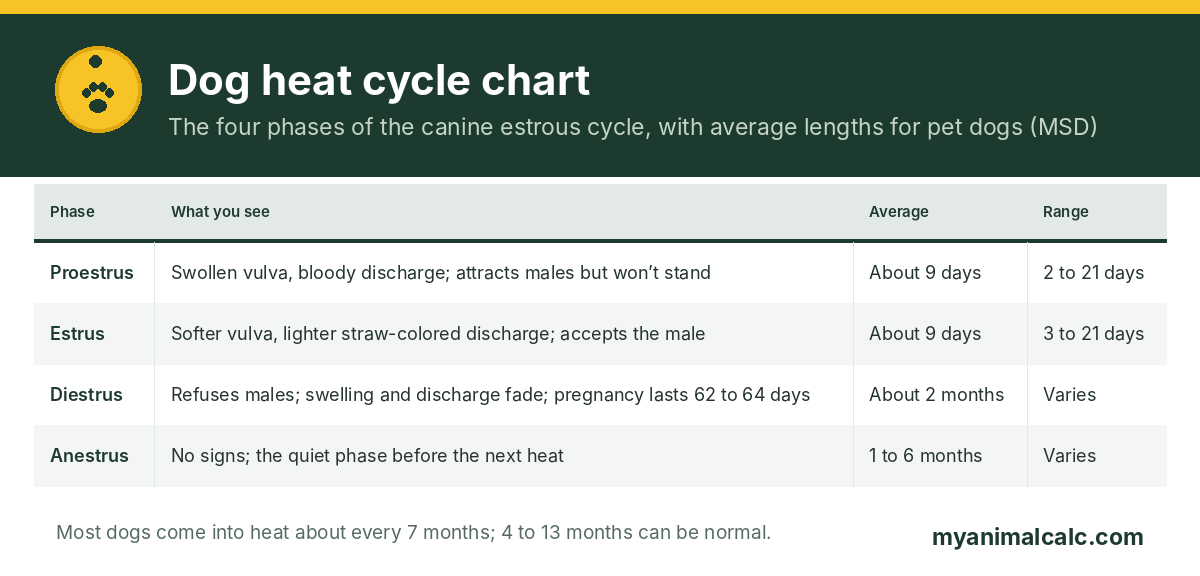
Dog heat cycle chart by phase
The four phases of the canine estrous cycle, with the average lengths MSD gives for pet dogs.
| Phase | What you see | Average | Range |
|---|---|---|---|
| Proestrus | Swollen vulva, bloody discharge; attracts males but won’t stand | About 9 days | 2 to 21 days |
| Estrus | Softer vulva, lighter straw-colored discharge; accepts the male | About 9 days | 3 to 21 days |
| Diestrus | Refuses males; swelling and discharge fade; pregnancy lasts 62 to 64 days | About 2 months | Varies |
| Anestrus | No signs; the quiet phase before the next heat | 1 to 6 months | Varies |
Proestrus and estrus together make up the 2 to 3 weeks most owners call a heat. The dog heat cycle calculator above dates each phase for your dog.
How often do dogs go into heat?
MSD says most female dogs cycle twice a year, with an average of 7 months between heats and a normal range of 4 to 13 months. Some large breeds, such as Great Danes, may cycle normally only every 9 to 12 months. University of Illinois teaching notes give the Basenji as a once-a-year breed and say some breeds, such as German Shepherds, can cycle as often as every 4 months, while the gap for any one dog stays fairly consistent. That is why two dates from her own history beat any average.
The American Kennel Club notes that most dogs have their first heat between 6 and 18 months of age, smaller breeds earlier and giant breeds later, and that heats continue throughout a dog’s life.
Which days is a dog fertile?
Ovulation happens during estrus, about 2 to 3 days after the LH peak, and the eggs need 1 to 3 more days to mature, while healthy sperm can survive for 5 to 11 days. With proestrus averaging about 9 days, the fertile days of an average heat fall around days 9 to 14, which is what the calculator shows. Individual dogs vary a lot, so for a planned mating ask your vet about progesterone tests.
If she is mated, the dog pregnancy calculator gives the whelping date, which MSD puts at 58 to 72 days after the first mating.
Caring for a dog in heat
- Keep her on a lead and away from intact males for the whole heat, about 3 weeks.
- Washable pants or dog diapers help with the discharge.
- In the weeks after a heat, call your vet the same day if she drinks a lot, vomits, seems dull or has a pus-like discharge.
Printable dog heat cycle chart
The chart above as an image, to save on your phone or print. Use the dog heat cycle calculator at the top of the page for any other date.
Plan a mating with the dog ovulation calculator and track the pregnancy with the dog pregnancy calculator and the pregnant dog food calculator.
Dog heat cycle calculator FAQs
How long does a dog stay in heat?
About 2 to 3 weeks. MSD gives about 9 days each for proestrus and estrus, though either can last from a few days to 3 weeks.
How often do dogs go into heat?
About every 7 months on average, or twice a year; 4 to 13 months can be normal, giant breeds every 9 to 12 months and Basenjis once a year.
When is a dog most fertile during heat?
Usually around days 9 to 14 of the heat, a few days into estrus, but it varies; progesterone tests show the exact days.
How accurate is a dog heat cycle calculator?
Most accurate when you enter two heat dates, because each dog’s cycle length is fairly consistent. With one date it uses an average, so the real date can differ by weeks.