| Liver injury | Seen from about 50 mg per kg; expected above 100 mg per kg |
|---|---|
| Red blood cell damage | Above about 200 mg per kg |
| One 325 mg tablet | 72 mg/kg for a 10 lb dog |
| Hidden sources | Cold and flu remedies, Excedrin, some prescription painkillers |
| What to do | Call your vet or a poison line now |
How to use the dog Tylenol toxicity calculator
- Enter your dog’s weight.
- Pick the product: Regular Strength (325 mg), Extra Strength (500 mg), 8 HR Arthritis (650 mg), children’s chewables or children’s liquid.
- Enter the number of tablets or milliliters your dog may have swallowed.
- Read the dose in mg/kg and the risk band, then call your vet.
How much Tylenol is toxic to a dog (chart by weight)
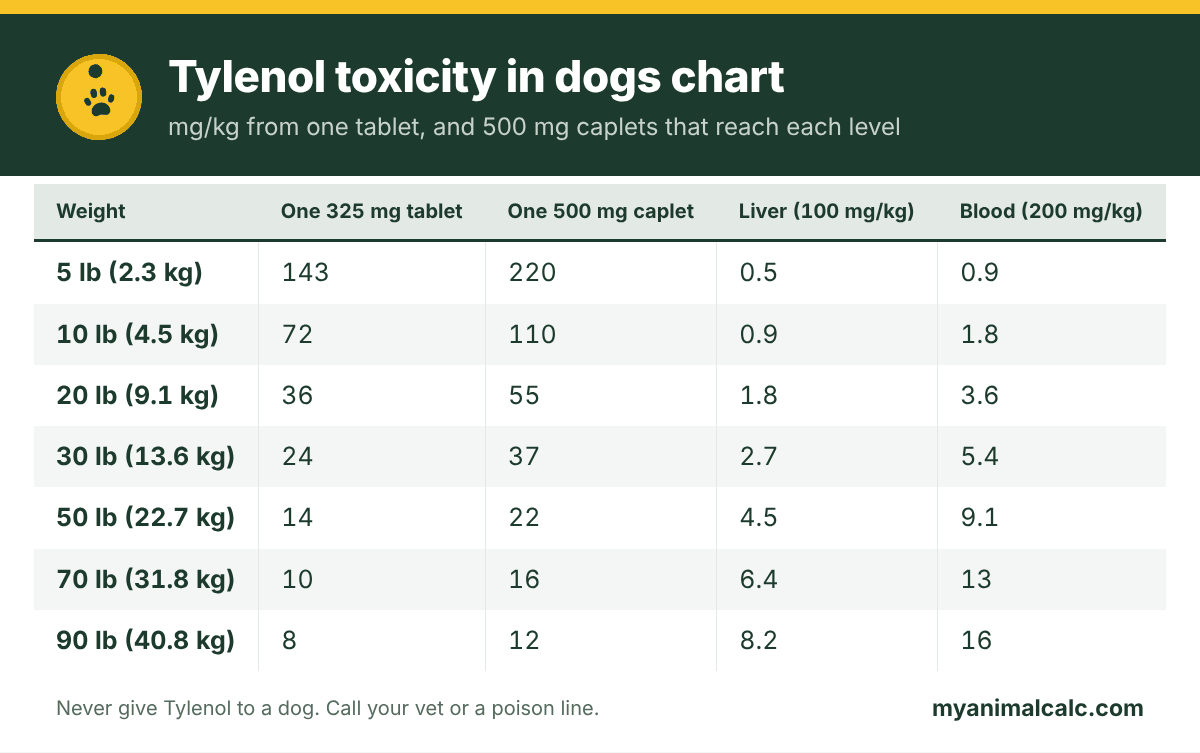
| Weight | One 325 mg tablet | One 500 mg caplet | Liver (100 mg/kg) | Blood (200 mg/kg) |
|---|---|---|---|---|
| 5 lb (2.3 kg) | 143 | 220 | 0.5 | 0.9 |
| 10 lb (4.5 kg) | 72 | 110 | 0.9 | 1.8 |
| 20 lb (9.1 kg) | 36 | 55 | 1.8 | 3.6 |
| 30 lb (13.6 kg) | 24 | 37 | 2.7 | 5.4 |
| 50 lb (22.7 kg) | 14 | 22 | 4.5 | 9.1 |
| 70 lb (31.8 kg) | 10 | 16 | 6.4 | 13 |
| 90 lb (40.8 kg) | 8 | 12 | 8.2 | 16 |
Toy and small breeds are most at risk, because one or two adult tablets is already a large dose for them. Small dogs can also develop dry eye after acetaminophen poisoning. If the pills were ibuprofen (Advil or Motrin), use the dog ibuprofen toxicity calculator instead.
Why acetaminophen harms dogs
The liver normally clears acetaminophen by attaching it to other molecules so it can be passed out. When a dog swallows more than its liver can handle, more of the drug is turned into a toxic by-product (NAPQI). This uses up the liver’s protective glutathione and then injures liver cells. At high doses it also changes hemoglobin into methemoglobin, which cannot carry oxygen, so the gums turn brown or bluish and the dog breathes fast.
Symptoms of Tylenol toxicity in dogs
- First 1 to 12 hours: vomiting, drooling, belly pain, fast breathing, weakness, brown or muddy gums, swelling of the face, paws or front legs.
- 1 to 3 days: loss of appetite, dark urine, yellow gums or eyes, tiredness, signs of liver damage. Liver problems can show up as late as a week after.
- Small breeds: squinting, eye discharge or pawing at the eyes from dry eye.
What to do if your dog ate Tylenol
Call your vet or a poison line immediately, even if your dog looks normal: the treatment works best before signs begin. If it was swallowed very recently, the vet may make your dog vomit and give activated charcoal. The antidote, N-acetylcysteine, refills the liver’s protective glutathione, and dogs may also receive SAMe, vitamin C, fluids, oxygen or a blood transfusion depending on the dose. Liver values are often rechecked over the following days. Dogs treated early usually recover fully.
Check the label for combination products
Many medicines contain acetaminophen alongside another drug, and the second drug can be just as dangerous. Cold and flu tablets may add decongestants such as pseudoephedrine or phenylephrine; night-time formulas add antihistamines; and prescription painkillers such as Percocet or Vicodin pair acetaminophen with an opioid. Read the full ingredient list to your vet.
Can I give my dog Tylenol for pain?
Only if your vet prescribes it. Vets do occasionally use acetaminophen in dogs, but they choose the dose for the individual dog after checking its liver and other medicines, which is why we do not publish a home dose. Never give acetaminophen to a cat: cats are poisoned by about 10 mg/kg, a small fraction of one tablet.
Printable tylenol toxicity in dogs chart
The chart above as an image, to save on your phone or print. Use the calculator at the top of the page for your own dog.
Also see the ibuprofen toxicity calculator and the aspirin toxicity calculator. Many cold remedies combine acetaminophen with decongestants or caffeine; for caffeine, use the caffeine toxicity calculator.
Tylenol toxicity in dogs FAQs
How much Tylenol is toxic to a dog?
Liver injury has been reported from about 50 mg/kg, liver damage is expected above 100 mg/kg, and red blood cell damage is likely above 200 mg/kg. For a 20 lb dog, 100 mg/kg is about 900 mg, fewer than two Extra Strength caplets.
My dog ate one Tylenol. Is that dangerous?
It depends on the size of the dog. One 500 mg Extra Strength caplet is about 110 mg/kg for a 10 lb dog, which is a liver risk, but about 16 mg/kg for a 70 lb dog. Call your vet either way.
How long does it take for Tylenol to affect a dog?
Signs can appear within 1 to 12 hours, but liver damage can take one to three days, or longer, to show. Treatment works best in the first few hours.
Can a dog survive Tylenol poisoning?
Yes. With early treatment, including the antidote N-acetylcysteine, the outlook is excellent. Delayed treatment and high doses can cause lasting liver damage.
Is Tylenol or ibuprofen worse for dogs?
Both are dangerous, in different ways. Ibuprofen mainly causes stomach ulcers and kidney damage; acetaminophen mainly harms the liver and red blood cells. Neither should be given without a vet’s advice.
Is Tylenol toxic to cats?
Yes, extremely. Cats cannot process acetaminophen well and can be poisoned by about 10 mg/kg. Any amount swallowed by a cat is an emergency.
How many mg of Tylenol is toxic to a dog?
Liver injury has been seen from about 50 mg of acetaminophen per kg, damage is expected above 100 mg/kg (45 mg per pound), and above 200 mg/kg red blood cells are damaged too. For a 30 lb dog, 100 mg/kg is about 1,360 mg, under three 500 mg caplets.