| Low blood sugar | From about 0.1 g per kg (45 mg per pound) |
|---|---|
| Liver failure risk | From about 0.5 g per kg |
| Signs start | 15 to 60 minutes, sometimes delayed 12 hours or more |
| Common sources | Sugar-free gum and mints, some peanut butters, sweeteners, baked goods, vitamins |
| What to do | Call your vet or a poison line now, even if your dog seems fine |
How to use the xylitol toxicity calculator
- Enter your dog’s weight in pounds or kilograms.
- Choose what it ate: gum, mints, granulated sweetener, or grams of xylitol if the label gives them.
- Enter how many pieces, mints or teaspoons are missing. If you are not sure, count the most it could have eaten.
- Read the dose in mg per kg and the risk band, then call your vet with that number.
Gum is the hardest product to judge. Brands that list xylitol as the first ingredient can hold about 1 g or more per piece, while others have about 0.2 to 0.3 g. When you don’t know the brand, the xylitol toxicity calculator counts each piece as 1 g, so it never underestimates the danger.
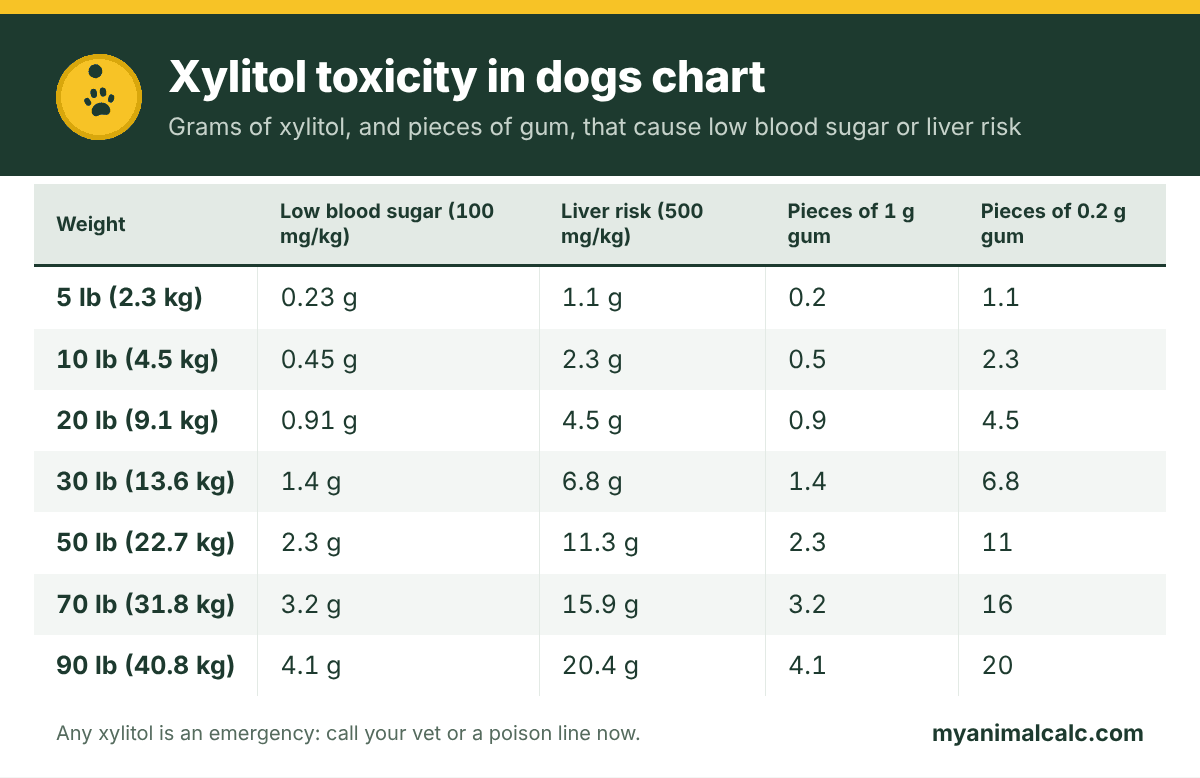
How much xylitol is toxic to dogs (chart by weight)
| Weight | Low blood sugar (100 mg/kg) | Liver risk (500 mg/kg) | Pieces of 1 g gum | Pieces of 0.2 g gum |
|---|---|---|---|---|
| 5 lb (2.3 kg) | 0.23 g | 1.1 g | 0.2 | 1.1 |
| 10 lb (4.5 kg) | 0.45 g | 2.3 g | 0.5 | 2.3 |
| 20 lb (9.1 kg) | 0.91 g | 4.5 g | 0.9 | 4.5 |
| 30 lb (13.6 kg) | 1.4 g | 6.8 g | 1.4 | 6.8 |
| 50 lb (22.7 kg) | 2.3 g | 11.3 g | 2.3 | 11 |
| 70 lb (31.8 kg) | 3.2 g | 15.9 g | 3.2 | 16 |
| 90 lb (40.8 kg) | 4.1 g | 20.4 g | 4.1 | 20 |
Small dogs are in danger from very little. A Chihuahua can reach the low blood sugar level from a single piece of strong gum, while a Labrador may need a whole pack. Both need a vet, because the amount in each piece varies so much between brands.
Why xylitol is so dangerous for dogs
In people, xylitol barely changes insulin. In dogs it is absorbed quickly and triggers a large release of insulin from the pancreas, which drives blood sugar down within minutes. At higher doses it also damages liver cells, by a mechanism that is still not fully understood. The Merck Veterinary Manual notes that dogs are the only domestic animal in which xylitol poisoning has been reported; cats are not considered at risk.
Products that can contain xylitol
- Sugar-free gum, breath mints and hard candy
- Some peanut and nut butters, especially “keto” or “no sugar added” brands
- Sugar-free baked goods, puddings and “skinny” ice cream
- Toothpaste, mouthwash and dental rinses for people
- Chewable vitamins, gummies (including melatonin) and supplements
- Liquid medicines and melt-in-the-mouth tablets, including some human gabapentin solutions
- Granulated sweetener, sometimes sold as “birch sugar”
Before giving your dog peanut butter or a human treat, read the ingredient list for xylitol or birch sugar. Most major peanut butter brands do not use it, but a few specialty ones do.
Symptoms of xylitol toxicity in dogs
| Time after eating | What you may see |
|---|---|
| 15 to 60 minutes | Vomiting, weakness, wobbling, sleepiness, trembling |
| 1 to 12 hours | Collapse, seizures or coma from low blood sugar. With some gums, signs can be delayed up to 12 to 18 hours |
| 24 to 72 hours | Signs of liver failure: yellow gums or eyes, bruising, bleeding, black stools, refusing food |
A dog can look normal for hours and still be heading for a crash, which is why vets treat the dose rather than waiting for symptoms.
What to do if your dog ate xylitol
- Call your vet or a poison line right away and give them the weight, the product and the amount.
- Don’t make your dog vomit at home unless they tell you to. Blood sugar can drop suddenly, and a weak dog can inhale vomit. Merck advises that vomiting be brought on only under veterinary supervision for xylitol (see hydrogen peroxide for dogs for when it is and isn’t safe).
- If your dog becomes weak or wobbly on the way, ask the vet whether to rub a little honey or corn syrup on its gums. Never put anything in the mouth of a dog that is having a seizure.
- Bring the wrapper so the clinic can work out the dose.
How vets treat xylitol poisoning
If your dog arrives early and is still bright, the vet may make it vomit with a drug. Activated charcoal is not used, because it does not bind xylitol. Dogs that ate more than 100 mg/kg are usually kept in hospital for at least 12 hours with blood sugar checks every one to two hours and a dextrose drip if needed. Above 500 mg/kg, vets also check liver values every day for about three days and may give liver-protecting medicines. Dogs treated for low blood sugar alone usually recover well; liver failure is much harder to treat.
Xylitol is one of several common kitchen poisons. If your dog also got into sweets or baking, check the chocolate toxicity calculator and the grape and raisin calculator too.
Printable xylitol toxicity in dogs chart
The chart above as an image, to save on your phone or print. Use the calculator at the top of the page for your own dog.
If your vet tells you to make your dog vomit, the hydrogen peroxide dosage for dogs calculator gives the amount. Other common kitchen poisons: chocolate, grapes and raisins and macadamia nuts.
Xylitol toxicity in dogs FAQs
Can one piece of gum kill a dog?
It can for a small dog. One piece of a xylitol-first gum holds about 1 g of xylitol, which is over 200 mg/kg for a 10 lb dog: well above the level that causes low blood sugar. Call your vet even after a single piece.
How much xylitol will kill a dog?
There is no single lethal number. Doses above 100 mg/kg can cause dangerous low blood sugar, and doses above 500 mg/kg can cause liver failure, which kills many affected dogs despite treatment. Quick veterinary care is what makes the difference.
How long after eating xylitol will a dog show symptoms?
Usually within 15 to 60 minutes, but some gums release xylitol slowly and signs can appear up to 12 to 18 hours later. Liver problems may not show for one to three days.
My dog ate sugar-free gum but seems fine. What should I do?
Call your vet or a poison line anyway. Many dogs look normal before their blood sugar falls, and the vet can decide from the dose whether your dog needs to come in.
Is peanut butter with xylitol safe for dogs?
No. Check the label for xylitol or birch sugar before sharing any peanut or nut butter, and choose one made with just peanuts and salt.
Is xylitol toxic to cats?
Cats are not known to be at risk, according to the Merck Veterinary Manual, and the FDA says it does not seem as dangerous for cats. It is still a good idea to keep sweetened products away from all pets.
Which gums have xylitol?
Many sugar-free gums and mints use xylitol, including many Trident and Ice Breakers products and xylitol gums such as Spry and Pür. Recipes change and differ between countries, so always check the ingredient list.