Canaries lay an egg a day, and many breeders use dummy eggs so the whole clutch hatches together.
| Incubation | About 13 days (12 to 14) from when she sits |
|---|---|
| Laying | An egg a day |
| Usual clutch | 3 to 6 eggs |
| Sitting usually starts | Once the clutch is complete |
| Hatching | Together, if she sits once the clutch is complete |
| Who sits | The hen |
How to use the canary egg incubation calculator
- Enter the day the first egg was laid.
- Choose the number of eggs and how often she laid them (daily is usual).
- Choose when she started sitting; after the last egg is usual when the eggs are swapped for dummies.
- Read the hatch date for each egg, the first and last hatch and when to give up on an egg that has not hatched.
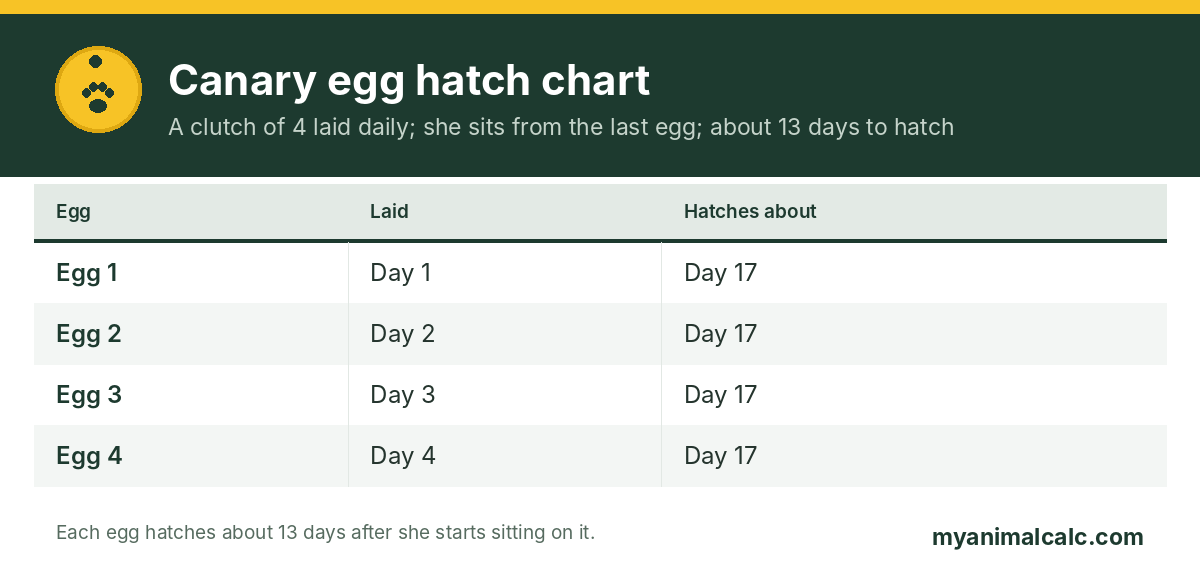
Canary egg hatch chart
A clutch of 4 laid daily, with the hen sitting from the last egg, counting the day the first egg was laid as day 1.
| Egg | Laid | Hatches about |
|---|---|---|
| Egg 1 | Day 1 | Day 17 |
| Egg 2 | Day 2 | Day 17 |
| Egg 3 | Day 3 | Day 17 |
| Egg 4 | Day 4 | Day 17 |
Change the clutch size or the day she started sitting in the canary egg incubation calculator above to see how the dates move.
How long do canary eggs take to hatch?
About 13 days: Oklahoma State gives 13, an avian veterinary guide 12 to 14, and Watchbird 13 to 14. A canary hen lays 3 to 6 eggs, one a day, usually 3 to 4 in larger types such as Yorkshires and 4 to 5 in smaller types such as Glosters.
Why the chicks hatch on different days
If the hen sits from the first egg, each chick hatches a day after the one before, and the youngest can struggle. Watchbird notes that most breeders take each new egg away and replace it with a plastic dummy until the clutch is complete, then return the real eggs, so the chicks all hatch around the same time, 13 to 14 days later. That is the calculator’s usual setting.
After the hatch
The hen does most of the brooding, and Watchbird notes that many males will also sit to keep the eggs or chicks warm. After the first week she spends more time off the nest and the chicks can be seen more easily. Young canaries are close-banded while small, and sit on the edge of the nest at about 18 to 19 days before they fledge.
Printable canary egg hatch chart
The chart above as an image, to save on your phone or print. Use the canary egg incubation calculator at the top of the page for any other date.
For finches, use the finch egg incubation calculator; for budgies, the budgie egg incubation calculator.
Canary egg incubation calculator FAQs
How long do canary eggs take to hatch?
About 13 to 14 days after the hen starts sitting.
How many eggs do canaries lay?
3 to 6, one a day.
Why do breeders use dummy eggs for canaries?
So the hen sits on the whole clutch at once and the chicks hatch together, giving each the same chance.
When should I give up on a canary egg?
If it has not hatched a couple of days after the 12 to 14 day window, it is unlikely to.