Lovebirds lay every other day, so the chicks usually hatch in laying order, a couple of days apart.
| Incubation | About 23 days (21 to 24) from when she sits |
|---|---|
| Laying | An egg every other day |
| Usual clutch | 4 to 6 eggs |
| Sitting usually starts | With the second egg |
| Hatching | In laying order, about 2 days apart |
| Who sits | The hen, often joined by the male at night |
How to use the lovebird egg incubation calculator
- Enter the day the first egg was laid.
- Choose the number of eggs and how often she laid them (every other day is usual).
- Choose when she started sitting tightly on the eggs; with the second egg is the usual choice for lovebirds.
- Read the hatch date for each egg, the first and last hatch and when to give up on an egg that has not hatched.
Lovebird egg hatch chart
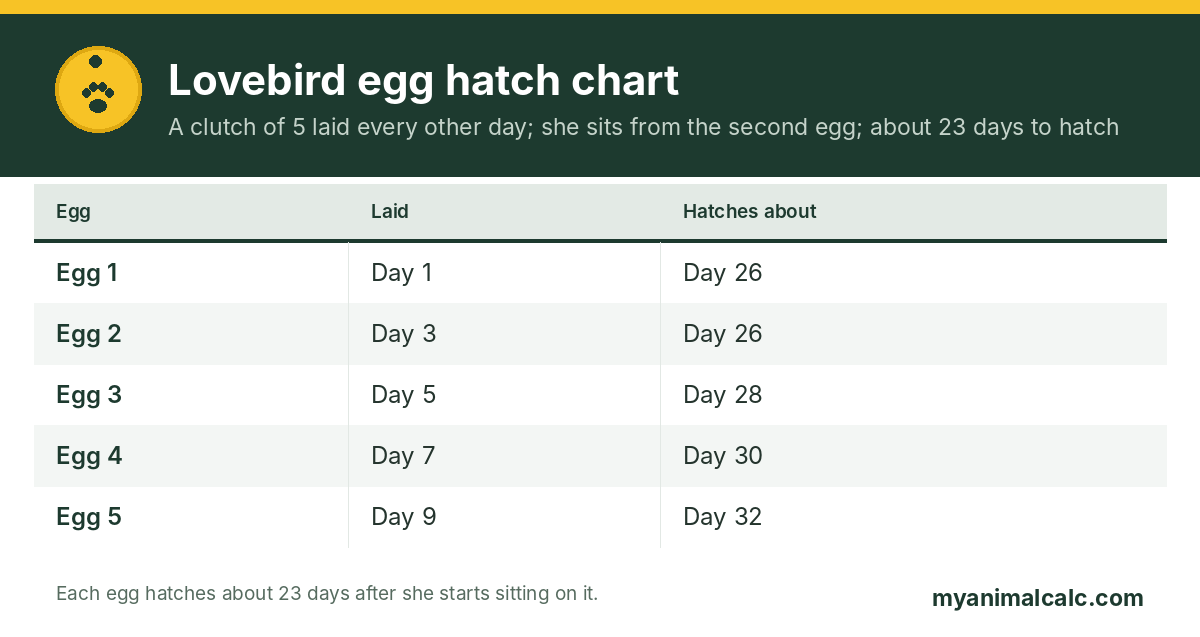
A clutch of 5 laid every other day, with the hen sitting from the second egg, counting the day the first egg was laid as day 1.
| Egg | Laid | Hatches about |
|---|---|---|
| Egg 1 | Day 1 | Day 26 |
| Egg 2 | Day 3 | Day 26 |
| Egg 3 | Day 5 | Day 28 |
| Egg 4 | Day 7 | Day 30 |
| Egg 5 | Day 9 | Day 32 |
Change the clutch size or the day she started sitting in the lovebird egg incubation calculator above to see how the dates move.
How long do lovebird eggs take to hatch?
About 23 days for each egg, according to Lafeber; a licensed veterinary technician writing for Petco gives 21 to 24 days for clutches of 4 to 6. Lafeber suggests counting from the day the last egg was laid and waiting about 5 days past the due date before giving up on an egg, which is how the calculator sets its give-up date.
Why the chicks hatch on different days
A Watchbird breeder notes that the hen lays an egg every other day, that some hens do not start sitting until two or three eggs are laid, and that if she sat from the first egg the babies hatch one every other day. The calculator gives each egg its own date from the day you choose.
When a lovebird lays without a mate
A single hen can lay infertile eggs. Leave them with her until she loses interest, usually after 3 to 4 weeks, rather than removing them at once, which can prompt her to lay more. Feed a fortified diet with extra calcium while she is laying.
Printable lovebird egg hatch chart
The chart above as an image, to save on your phone or print. Use the lovebird egg incubation calculator at the top of the page for any other date.
For budgies, use the budgie egg incubation calculator; for cockatiels, the cockatiel egg incubation calculator.
Lovebird egg incubation calculator FAQs
How long do lovebird eggs take to hatch?
About 23 days after the hen starts sitting on each egg; 21 to 24 days is usual.
How often do lovebirds lay eggs?
Every other day, usually 4 to 6 eggs.
When should I give up on lovebird eggs?
Lafeber suggests waiting about 5 days past the due date of the last egg.
Can a lovebird lay eggs without a male?
Yes, but the eggs will be infertile and will not hatch.