| Under 20 kg (44 lb) | 2 to 4 mg every 8 to 12 hours |
|---|---|
| Over 20 kg | 8 mg every 8 to 12 hours |
| Products | Plain 4 mg tablets or 2 mg per 5 mL syrup |
| Never | Extended-release 12 mg tablets or “-D” decongestant products |
| Common effect | Sleepiness |
| Prescription | No, but ask your vet first |
How to use the chlorpheniramine dosage for dogs calculator
- Enter your dog’s weight from a recent weigh-in, in pounds or kilograms.
- Choose the chlorpheniramine product you have.
- Enter the dose you were told to give (optional) to check it against the usual range.
- Tick any that apply. Some answers stop the result, because a vet needs to decide.
- Read the result: the dose in mg, the amount of your product, and how often.
Chlorpheniramine dosage for dogs chart by weight
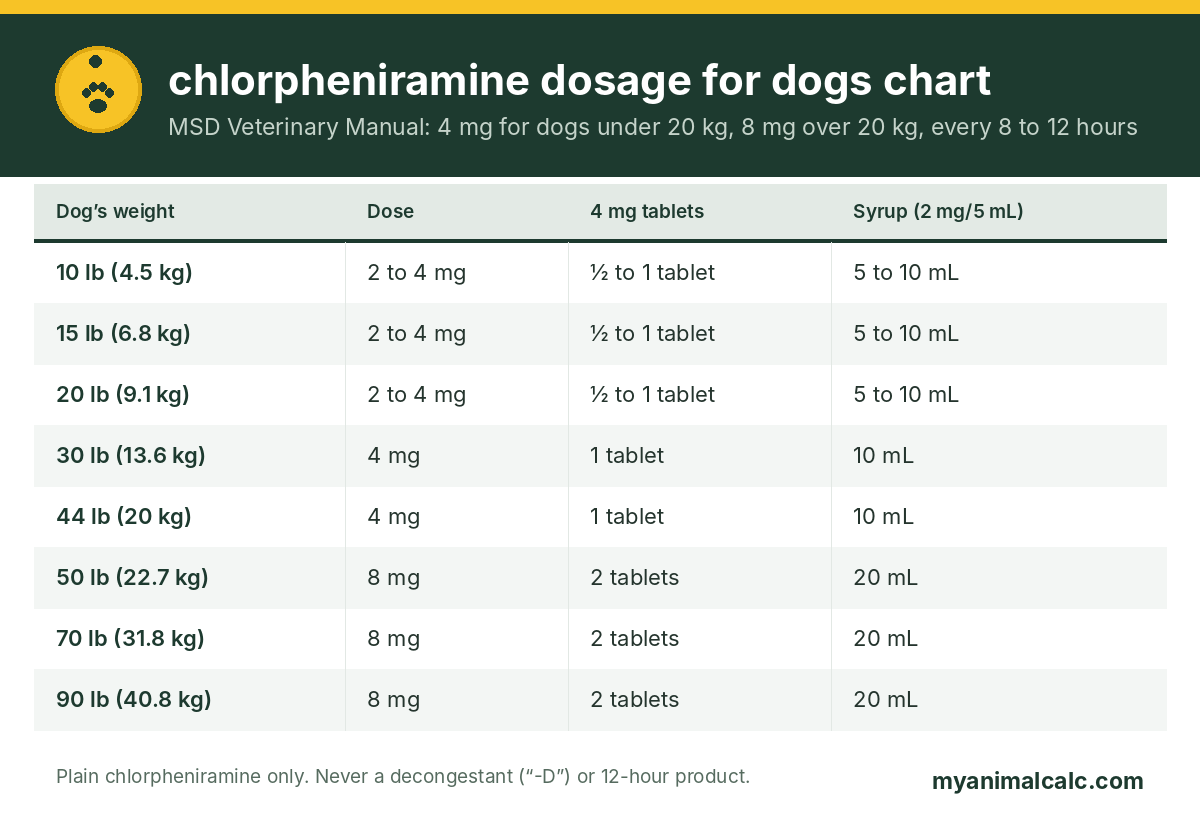
Per dose, every 8 to 12 hours, using plain 4 mg tablets or syrup with 2 mg per 5 mL (0.4 mg per mL).
| Dog’s weight | Dose | 4 mg tablets | Syrup (2 mg/5 mL) |
|---|---|---|---|
| 10 lb (4.5 kg) | 2 to 4 mg | ½ to 1 tablet | 5 to 10 mL |
| 15 lb (6.8 kg) | 2 to 4 mg | ½ to 1 tablet | 5 to 10 mL |
| 20 lb (9.1 kg) | 2 to 4 mg | ½ to 1 tablet | 5 to 10 mL |
| 30 lb (13.6 kg) | 4 mg | 1 tablet | 10 mL |
| 44 lb (20 kg) | 4 mg | 1 tablet | 10 mL |
| 50 lb (22.7 kg) | 8 mg | 2 tablets | 20 mL |
| 70 lb (31.8 kg) | 8 mg | 2 tablets | 20 mL |
| 90 lb (40.8 kg) | 8 mg | 2 tablets | 20 mL |
For dogs under 10 lb, ask your vet: even half a tablet is a large dose for them.
Does chlorpheniramine work for dogs?
Antihistamines help only some itchy dogs, and they work best given regularly before the allergy flares, not as a rescue. Veterinary dermatologists see them as a mild option or an add-on to fatty acid supplements and medicated baths. If your dog is still itchy after a week or two, newer prescription medicines are far more effective.
Which chlorpheniramine products are safe
Use only plain chlorpheniramine maleate 4 mg tablets or a plain syrup. Avoid any product with “D”, “decongestant”, “cold”, “sinus” or “PE” on the box, because pseudoephedrine and phenylephrine are dangerous for dogs. Avoid 12-hour or extended-release 12 mg tablets, which can’t be split and hold too much for most dogs. Check liquids for xylitol.
Chlorpheniramine side effects and warnings
Sleepiness is the most common side effect; some dogs become restless instead, and dry mouth and urine retention are possible. Avoid it in dogs with glaucoma, heart disease, seizures or bladder problems, and in pregnant dogs, unless your vet advises it. Mild signs of overdose can start below 1 mg/kg in dogs, so stick to the dose.
If your dog ate a combination cold tablet or many chlorpheniramine tablets, call your vet or an animal poison line now: ASPCA (888) 426-4435 or Pet Poison Helpline (855) 764-7661 (a fee may apply).
Printable chlorpheniramine dosage for dogs chart
The chart above as an image, to save on your phone or print. Use the calculator at the top of the page for your own dog.
Other antihistamines: the Zyrtec dosage for dogs calculator, the Claritin dosage for dogs calculator, the Allegra dosage for dogs calculator and the hydroxyzine dosage for dogs calculator. If your dog ate a decongestant, use the dog pseudoephedrine toxicity calculator.
Chlorpheniramine dosage for dogs FAQs
How much chlorpheniramine can I give my dog?
The MSD Veterinary Manual gives 4 mg every 8 hours for dogs under 20 kg and 8 mg for dogs over 20 kg. Ask your vet before the first dose.
Can I give my dog Chlor-Trimeton 12 hour?
No. Extended-release 12 mg tablets hold too much for most dogs and can’t be split. Use plain 4 mg tablets.
Is chlorpheniramine the same as Benadryl?
No. Both are first-generation antihistamines, but Benadryl is diphenhydramine and has a different dose.
Will chlorpheniramine make my dog sleepy?
Often, yes. Sleepiness is its most common side effect.