| Wounds and teeth | 5.5 mg/kg every 12 hours for 7 to 10 days |
|---|---|
| Skin infection | 11 mg/kg once a day for at least 21 days |
| Bone infection | 11 mg/kg every 12 hours for at least 28 days |
| Forms | 25, 75, 150 and 300 mg capsules; Aquadrops 25 mg per mL |
| Prescription needed | Yes |
How to use the Clindamycin dosage for dogs calculator
- Enter your dog’s weight in pounds or kilograms, from a recent weigh-in.
- Choose what Clindamycin is prescribed for and the capsule or liquid you have.
- Type the dose on your label (optional) to check it against the usual range for your dog’s weight.
- Read the result: the mg per dose, how often, the daily total and how much of your capsule or liquid that is.
Clindamycin dosage for dogs chart by weight
Doses for wounds, abscesses and tooth infections, at 5.5 to 11 mg/kg every 12 hours (AAHA range for skin infections).
| Weight | Per dose | 75 mg capsules | 150 mg capsules | Aquadrops 25 mg/mL |
|---|---|---|---|---|
| 5 lb (2.3 kg) | 12–25 mg | ask your vet | ask your vet | 0.5–0.9 mL |
| 10 lb (4.5 kg) | 25–50 mg | ask your vet | ask your vet | 1–1.9 mL |
| 20 lb (9.1 kg) | 50–100 mg | 1 × 75 mg | ask your vet | 2–3.9 mL |
| 30 lb (13.6 kg) | 75–150 mg | 1 × 75 mg | 1 × 150 mg | 3–5.9 mL |
| 50 lb (22.7 kg) | 125–249 mg | 2–3 × 75 mg | 1 × 150 mg | 5–9.9 mL |
| 70 lb (31.8 kg) | 175–349 mg | 3–4 × 75 mg | 2 × 150 mg | 7–13.9 mL |
| 90 lb (40.8 kg) | 225–449 mg | ask your vet | 2 × 150 mg | 9–17.9 mL |
For skin and bone infections, switch the calculator to the 11 mg/kg dose.
Clindamycin dosage for dogs per pound and per kg
The clindamycin dosage for dogs is 5.5 to 11 mg per kg, which is 2.5 to 5 mg per pound, every 12 hours. To work it out by hand, multiply your dog’s weight in pounds by 2.5 to 5 to get the mg of clindamycin, then round to the nearest piece your tablets can be split into.
Clindamycin dosage for dogs by weight, with examples
Here is what the Clindamycin dosage for dogs works out to at four common weights, rounded the same way as the calculator. These are the usual label or reference doses; the dose on your dog’s prescription comes first.
Clindamycin dosage for a 10 lb dog
A 10 lb (4.5 kg) dog usually gets:
- Wounds, abscesses and tooth infections: 25–50 mg of clindamycin every 12 hours (1 × 25 mg capsule or 1–1.9 mL of Antirobe Aquadrops (25 mg/mL))
- Skin infection: 50 mg of clindamycin once a day (2 × 25 mg capsule or 2 mL of Antirobe Aquadrops (25 mg/mL))
- Bone infection: 50 mg of clindamycin every 12 hours (2 × 25 mg capsule or 2 mL of Antirobe Aquadrops (25 mg/mL))
Clindamycin dosage for a 25 lb dog
A 25 lb (11.3 kg) dog usually gets:
- Wounds, abscesses and tooth infections: 62–125 mg of clindamycin every 12 hours (3–4 × 25 mg capsule, 1 × 75 mg capsule or 2.5–4.9 mL of Antirobe Aquadrops (25 mg/mL))
- Skin infection: 125 mg of clindamycin once a day (5 mL of Antirobe Aquadrops (25 mg/mL))
- Bone infection: 125 mg of clindamycin every 12 hours (5 mL of Antirobe Aquadrops (25 mg/mL))
Clindamycin dosage for a 50 lb dog
A 50 lb (22.7 kg) dog usually gets:
- Wounds, abscesses and tooth infections: 125–249 mg of clindamycin every 12 hours (2–3 × 75 mg capsule, 1 × 150 mg capsule or 5–9.9 mL of Antirobe Aquadrops (25 mg/mL))
- Skin infection: 249 mg of clindamycin once a day (3 × 75 mg capsule or 10 mL of Antirobe Aquadrops (25 mg/mL))
- Bone infection: 249 mg of clindamycin every 12 hours (3 × 75 mg capsule or 10 mL of Antirobe Aquadrops (25 mg/mL))
Clindamycin dosage for an 80 lb dog
An 80 lb (36.3 kg) dog usually gets:
- Wounds, abscesses and tooth infections: 200–399 mg of clindamycin every 12 hours (2 × 150 mg capsule, 1 × 300 mg capsule or 8–15.9 mL of Antirobe Aquadrops (25 mg/mL))
- Skin infection: 399 mg of clindamycin once a day (3 × 150 mg capsule or 16 mL of Antirobe Aquadrops (25 mg/mL))
- Bone infection: 399 mg of clindamycin every 12 hours (3 × 150 mg capsule or 16 mL of Antirobe Aquadrops (25 mg/mL))
What clindamycin treats in dogs
Clindamycin works well against the bacteria found in mouths, deep wounds and bone, including anaerobes, and gets into bone well. It is a common choice for tooth root abscesses and infected bite wounds, and AAHA lists it as a first-tier antibiotic for skin infections. It is also used for toxoplasmosis. Some UK labels add a 10-day course around dental surgery, from 5 days before to 5 days after.
How to give clindamycin
Give capsules with food and a little water so they don’t stick in the gullet, and space doses 12 hours apart. Aquadrops are bitter, so mix the dose into a small amount of tasty food. Finish the course even if the swelling goes down: tooth and wound infections are usually treated for 7 to 10 days, skin infections for at least 3 weeks and bone infections for at least 4.
Clindamycin side effects
Vomiting and loose stools are the most common side effects. Stop and call your vet if your dog gets severe or bloody diarrhea. Dogs with liver or kidney disease may need lower doses and blood tests during long courses. Don’t give it to a dog that has reacted to clindamycin or lincomycin before. If your dog swallowed more than it should, call your vet or an animal poison line: ASPCA (888) 426-4435 or Pet Poison Helpline (855) 764-7661 (a fee may apply).
Printable Clindamycin dosage for dogs chart
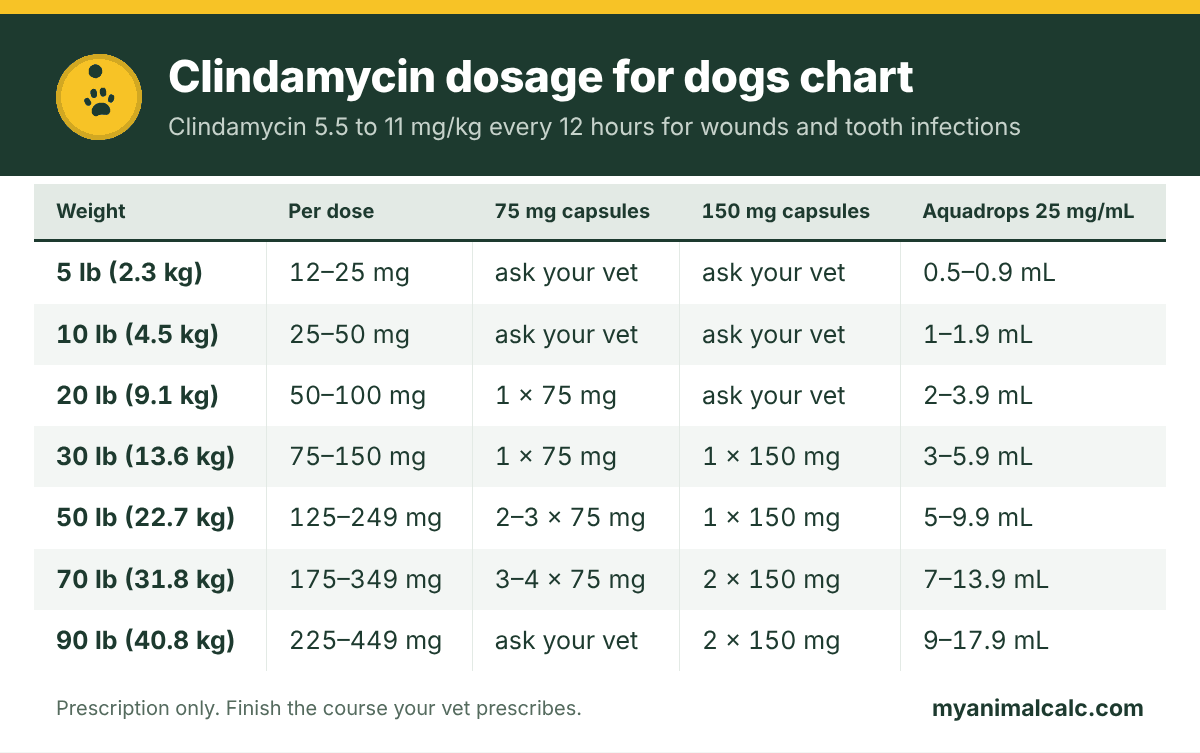
The same Clindamycin chart as an image, to save on your phone or print. The calculator at the top of the page gives the exact amount for your dog’s weight and product.
Compare the amoxicillin dosage for dogs calculator, the Clavamox dosage for dogs calculator and the cephalexin dosage for dogs calculator.
Clindamycin dosage for dogs FAQs
How much clindamycin do I give my dog?
5.5 mg per kg (2.5 mg per lb) every 12 hours for wounds and tooth infections, up to 11 mg per kg. A 60 lb (27 kg) dog usually gets 150 mg every 12 hours.
How long does a dog take clindamycin for a tooth infection?
Usually 7 to 10 days, and up to 28 days if your vet thinks it needs longer.
Is clindamycin 150 mg safe for dogs?
At the right weight. 150 mg twice a day suits a dog of about 14 to 27 kg (30 to 60 lb) at 5.5 to 11 mg per kg.
Should clindamycin be given with food?
Yes. Food and a little water after the capsule reduce vomiting and stop it from sticking in the gullet.
What are the side effects of clindamycin in dogs?
Vomiting and loose stools are the most common. Severe or bloody diarrhea needs a call to your vet.
How do I give Antirobe Aquadrops?
Measure the dose with the dropper, then squirt it into the side of the mouth or mix it into a small amount of food. It is bitter, so a tasty mixer helps.