| Most dogs | 7 days |
|---|---|
| Puppies, seniors, sensitive stomachs | 10 to 14 days |
| Steps | 75/25, then 50/50, then 25/75 old to new, then all new |
| Different calories | Use each food’s own daily amount, so calories stay the same |
| Upset stomach | Go back a step for 2 or 3 days, then go more slowly |
How to use the dog food transition calculator
- Choose how you measure: cups, grams or cans.
- Enter the daily amount of the old food and of the new food. Leave the new food blank if the amount is the same.
- Pick the schedule: 7, 10 or 14 days, and how many meals a day.
- Follow the table: each row gives the old and new food for those days, and the new food per meal.
Dog food transition chart for 7, 10 and 14 days
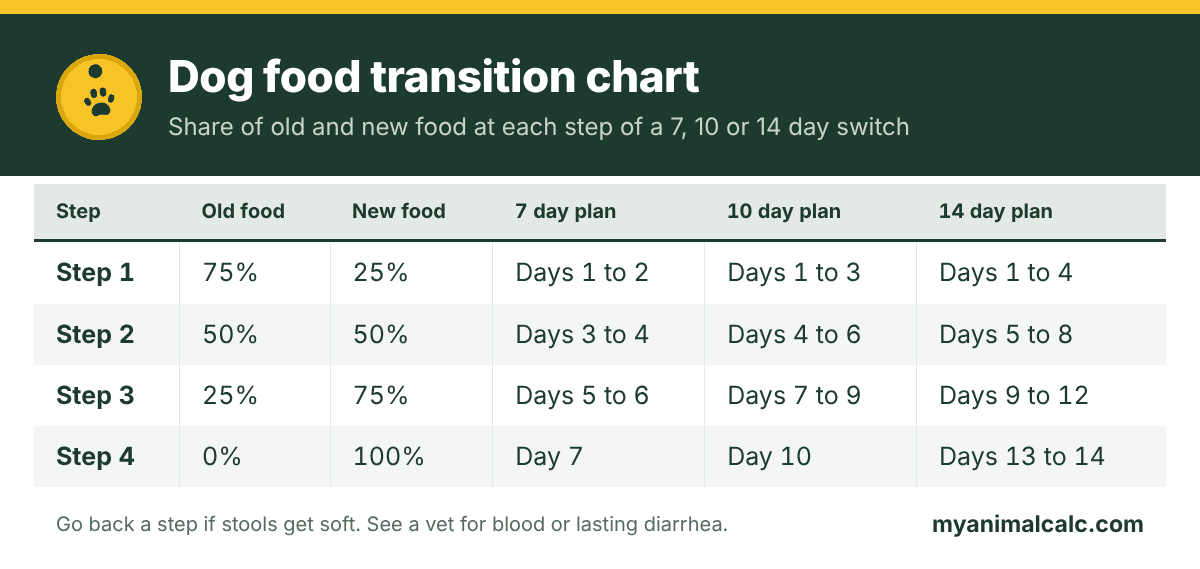
The same four steps are used for every schedule; longer schedules simply spend more days on each step.
| Step | Old food | New food | 7 day plan | 10 day plan | 14 day plan |
|---|---|---|---|---|---|
| Step 1 | 75% | 25% | Days 1 to 2 | Days 1 to 3 | Days 1 to 4 |
| Step 2 | 50% | 50% | Days 3 to 4 | Days 4 to 6 | Days 5 to 8 |
| Step 3 | 25% | 75% | Days 5 to 6 | Days 7 to 9 | Days 9 to 12 |
| Step 4 | 0% | 100% | Day 7 | Day 10 | Days 13 to 14 |
Why switch dog food gradually
A dog’s gut bacteria and digestive enzymes are tuned to the food it eats every day. A sudden change, even between two good foods, can bring on vomiting, diarrhea, gas or a dog that refuses its bowl. A gradual dog food transition gives the gut about a week to adapt, which is why most food makers and vets recommend it.
Switching to a food with different calories
Foods differ in calories per cup, so the new food’s daily amount may not be the same as the old one. Suppose your dog eats 2 cups a day of a food with 400 kcal per cup (800 kcal). A new food with 450 kcal per cup gives the same calories in about 1 ¾ cups. On days 3 and 4 your dog would then get 1 cup of the old food and ⅞ cup of the new one. Enter both daily amounts in the calculator and it does this for every step; the dog food calculator gives the right daily amount of the new food.
When to skip the slow switch
Sometimes a slow switch isn’t possible or wise: when a food has been recalled, when your dog reacts badly to the current food, or when your vet starts a bland or prescription diet for an upset stomach. Follow your vet’s advice in those cases. If you simply run out of the old food, feed the new food in smaller meals more often for a few days and watch the stools.
Switching from kibble to wet or raw food
Changing the type of food is a bigger change than changing brands, so allow 10 to 14 days. Wet and raw foods have far fewer calories per cup or ounce because they are mostly water, so work out the new daily amount first: the raw dog food calculator covers raw feeding, and wet food labels give the calories per can.
Printable dog food transition chart
The chart above as an image, to save on your phone or print. Use the calculator at the top of the page for your own dog.
Switching to an adult food? See the puppy feeding calculator for the age to switch. Comparing foods first? The dog food cost calculator and the dog food kcal calculator help.
Dog food transition FAQs
How long does it take to switch dog food?
About 7 days for most healthy dogs, and 10 to 14 days for puppies, older dogs, dogs with a sensitive stomach, or a change from kibble to wet or raw food.
Can I switch dog food without mixing?
It often causes a few days of soft stools or an upset stomach. If you have no old food left, give the new food in smaller, more frequent meals and call your vet if your dog vomits or the diarrhea lasts more than a day or two.
What should I do if my dog gets diarrhea when switching food?
Go back to the last mix your dog handled well for 2 or 3 days, then move forward more slowly. See your vet if there is blood, vomiting, or diarrhea lasting more than a day or two.
How do I switch my puppy to adult food?
Use the same 7 to 10 day schedule when your puppy reaches adult size: around 9 to 12 months for small and medium breeds and 12 to 24 months for large and giant breeds.
Is it normal for my dog’s poop to change when I switch food?
Some change in colour, smell or firmness is normal while the gut adapts. Very loose stools, mucus or blood are not, and mean you should slow down or call your vet.
Should I give new treats during a food switch?
Better not. Keep everything else the same during the dog food transition, so if your dog’s stomach is upset you know the new food is the cause.