| Dose in mg | Dose per kg × weight in kg |
|---|---|
| Pounds to kg | Divide by 2.2 (1 lb = 0.454 kg) |
| Tablets | mg ÷ mg per tablet, rounded to halves or quarters |
| Liquid | mg ÷ mg per mL |
| mcg | 1 mg = 1,000 mcg |
| Use | Only with a dose your vet prescribed |
How to use the dog medication dosage calculator calculator
- Enter your dog’s weight in pounds or kilograms.
- Enter the prescribed dose and its unit: mg per kg, mg per lb or mcg per kg.
- Choose tablets, capsules or liquid and enter the strength on the label; for tablets, say whether they can be split.
- Read the mg per dose, the amount to give and the daily total.
Dog medication dosage chart (worked example)
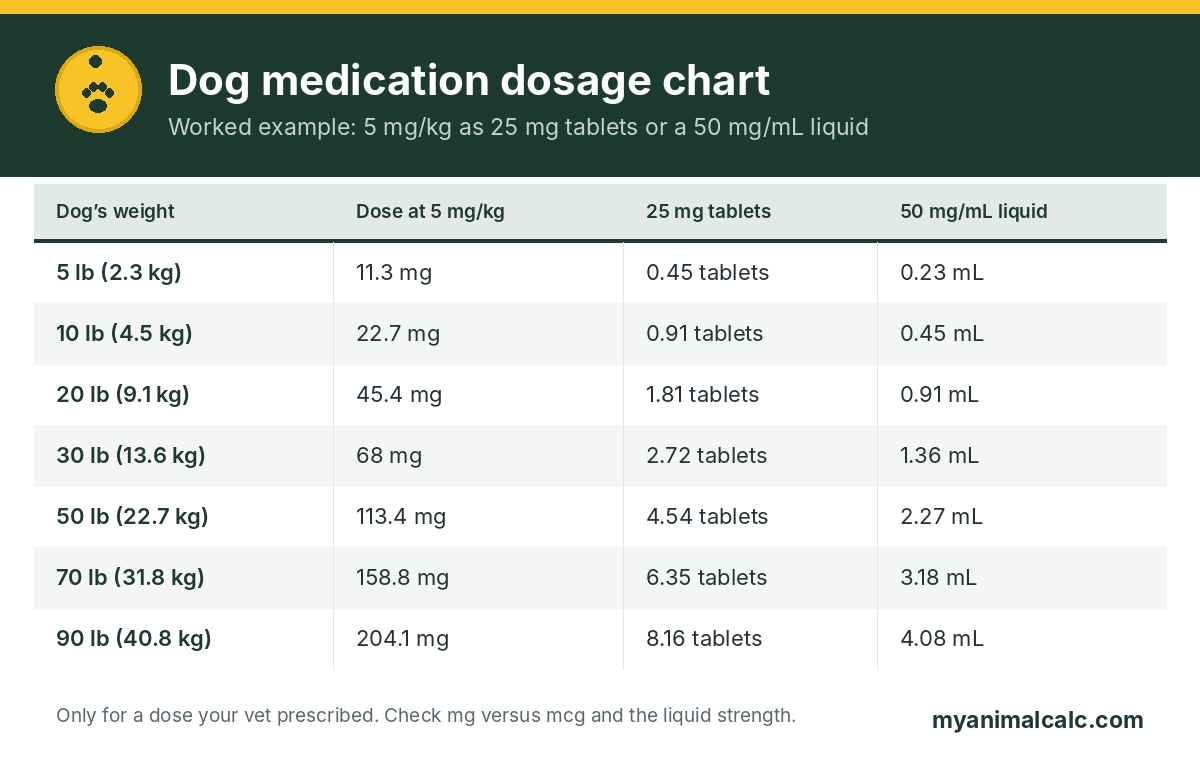
An example for a medicine prescribed at 5 mg/kg, with 25 mg tablets or a 50 mg per mL liquid. Your dog’s medicine will have its own dose.
| Dog’s weight | Dose at 5 mg/kg | 25 mg tablets | 50 mg/mL liquid |
|---|---|---|---|
| 5 lb (2.3 kg) | 11.3 mg | 0.45 tablets | 0.23 mL |
| 10 lb (4.5 kg) | 22.7 mg | 0.91 tablets | 0.45 mL |
| 20 lb (9.1 kg) | 45.4 mg | 1.81 tablets | 0.91 mL |
| 30 lb (13.6 kg) | 68 mg | 2.72 tablets | 1.36 mL |
| 50 lb (22.7 kg) | 113.4 mg | 4.54 tablets | 2.27 mL |
| 70 lb (31.8 kg) | 158.8 mg | 6.35 tablets | 3.18 mL |
| 90 lb (40.8 kg) | 204.1 mg | 8.16 tablets | 4.08 mL |
In practice the tablet amount is rounded to a half or quarter that can be split, and liquids to what the syringe can measure.
How to calculate a dog’s medicine dose
First turn the weight into kilograms by dividing pounds by 2.2. Multiply by the dose per kg to get the mg per dose. Then divide by the strength on the label: mg per tablet for tablets, or mg per mL for a liquid. For example, a 44 lb (20 kg) dog prescribed 5 mg/kg needs 100 mg, which is 4 tablets of 25 mg or 2 mL of a 50 mg/mL liquid.
Common dosing mistakes to avoid
The most dangerous errors are unit mix-ups: mg and mcg differ a thousandfold, and many liquids come in more than one strength, such as 50 mg per 5 mL versus 50 mg per mL. The FDA also warns that a trailing zero can make 5 mg look like 50 mg. Check that the dose is per kg and not per lb, use a recent weight, and ask your vet to show you how to use the syringe. Human liquids and melts can contain xylitol, and “-D” products contain decongestants, both dangerous for dogs.
When the tablet strength doesn’t fit
If the calculated amount is less than half a tablet, or a strange fraction, ask your vet or pharmacist about a smaller strength, a liquid or a compounded form rather than guessing. Some tablets must not be split or crushed: extended-release tablets, coated tablets and capsules. The dog medication dosage calculator flags amounts that are more than 10% off the dose after rounding.
If your dog got too much medicine
If your dog got a double dose, the wrong medicine or a human medicine, call your vet or an animal poison line: ASPCA (888) 426-4435 or Pet Poison Helpline (855) 764-7661 (a fee may apply). Have the bottle in hand so you can read out the drug, the strength and how much was given; the dog medication dosage calculator can show how many mg per kg that was.
Printable dog medication dosage chart
The chart above as an image, to save on your phone or print. Use the calculator at the top of the page for your own dog.
For named medicines with their label ranges, use calculators such as the carprofen dosage for dogs calculator, the gabapentin dosage for dogs calculator and the amoxicillin dosage for dogs calculator. For mg/m² doses, see the dog body surface area calculator.
Dog medication dosage calculator FAQs
How do I calculate mg per kg for my dog?
Divide your dog’s weight in pounds by 2.2 to get kg, then multiply by the dose per kg. A 30 lb dog at 2 mg/kg needs about 27 mg.
How do I convert a mg dose into mL?
Divide the mg by the strength of the liquid in mg per mL. 100 mg of a 50 mg/mL liquid is 2 mL.
Is mg/kg the same as mg/lb?
No. A dose per lb is 2.2 times the dose per kg. Always check which one is on the prescription.
Can I use this to choose a dose for my dog?
No. Use it only to turn a dose your vet prescribed into tablets or mL. Doses depend on the drug, the condition and your dog’s health.