| Small-breed male | About 6 months |
|---|---|
| Small-breed female | 5 to 6 months, before the first heat |
| Large-breed male | After growth stops, 9 to 15 months |
| Large-breed female | 5 to 15 months, decided with your vet |
| Dividing line | An expected adult weight of 45 lb |
How to use the dog spay and neuter age calculator
- Choose female (spay) or male (neuter).
- Enter the weight your dog will reach as an adult, from the breed standard, the parents or your vet’s estimate.
- Add the date of birth to turn the age window into dates.
- Read the age window and the notes on the trade-offs, then book a consult with your vet.
Dog spay and neuter age chart
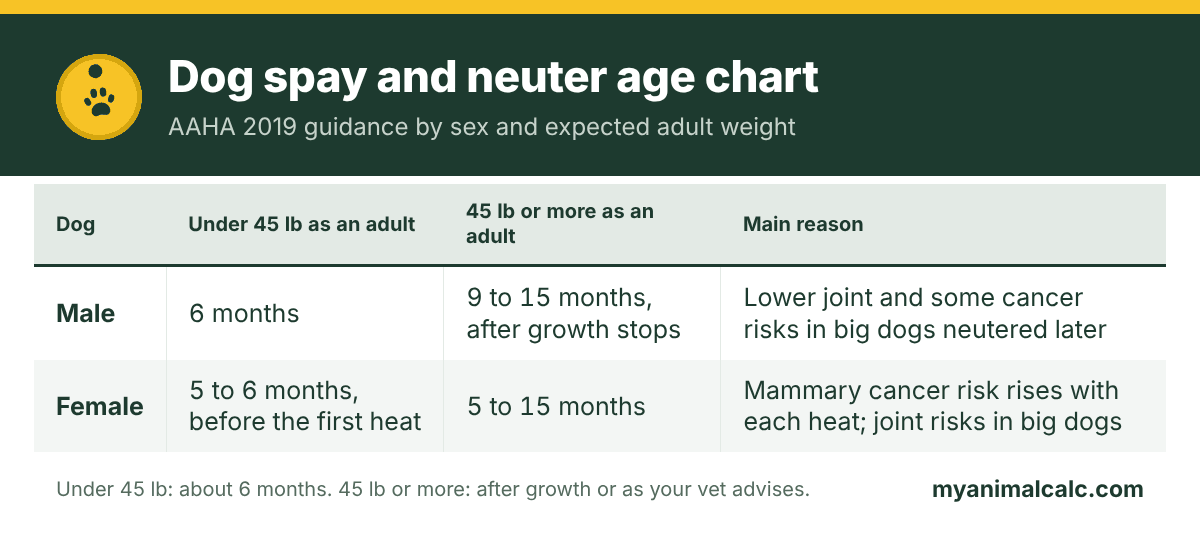
The AAHA 2019 guidance on when to sterilize dogs that are not intended for breeding, by sex and expected adult size.
| Dog | Under 45 lb as an adult | 45 lb or more as an adult | Main reason |
|---|---|---|---|
| Male | 6 months | 9 to 15 months, after growth stops | Lower joint and some cancer risks in big dogs neutered later |
| Female | 5 to 6 months, before the first heat | 5 to 15 months | Mammary cancer risk rises with each heat; joint risks in big dogs |
Shelter and rescue dogs are often sterilized from 8 weeks so that no animal leaves unsterilized, which AAHA accepts for that setting.
Why size changes the dog spay and neuter age
Sex hormones help close the growth plates in the long bones. Studies in some large breeds, such as Golden Retrievers, Labradors and German Shepherds, linked early neutering with more hip dysplasia, cruciate ligament tears and some cancers, while small breeds showed little change. That is why AAHA suggests waiting until growth stops in large-breed males. For large-breed females the picture is mixed, so AAHA gives a wide window and leaves the choice to you and your vet.
The case for spaying before the first heat
Mammary (breast) tumors are among the most common tumors in intact female dogs, and the risk is lowest when a dog is spayed before her first heat. Spaying also prevents pyometra, a life-threatening womb infection that affects many intact older females, and stops unplanned litters. Against that, early spaying is linked with urinary incontinence in some large females and with the joint risks above. Small breeds often have their first heat at about 6 months, so plan early.
Breed-specific advice
Hart and colleagues (2020) studied 35 breeds and found that in many of them, mostly the smaller ones, neutering age made little difference to joint disorders or cancers, while several large breeds did better when neutering waited until after a year. If your dog is one of the breeds they studied, ask your vet to look at the breed-specific findings before you book. Behavior is another factor: neutering reduces roaming and marking in many males, but it is not a cure for aggression or fear.
Printable dog spay and neuter age chart
The chart above as an image, to save on your phone or print. Use the calculator at the top of the page for your own dog.
Track a female’s cycles with the dog heat cycle calculator, and plan the puppy months with the puppy vaccination schedule calculator.
Dog spay and neuter age FAQs
What is the best age to neuter a dog?
About 6 months for dogs under 45 lb as adults, and after growth stops, usually 9 to 15 months, for larger males, according to AAHA.
When should I spay my female dog?
Small breeds before the first heat, at 5 to 6 months. Large breeds at 5 to 15 months, weighing mammary cancer risk against joint and other risks with your vet.
Is it bad to neuter a large dog too early?
In some large breeds, early neutering is linked with more joint disorders and some cancers, which is why AAHA suggests waiting until growth stops for large-breed males.
Can a dog be spayed while in heat?
Many vets prefer to wait 2 to 3 months after a heat, when the blood supply to the womb is smaller and surgery is safer.
Is it too late to spay or neuter an older dog?
No. Older dogs can be spayed or neutered after a health check; it still prevents pyometra, testicular cancer and litters.
Does neutering calm a dog down?
It often reduces roaming, marking and mounting, but training and exercise matter more for energy and behavior.