| Emergency signs | Retching with nothing coming up, a swollen or tight belly, restlessness, drooling, pale gums |
|---|---|
| How fast | Life-threatening within 1 to 2 hours if untreated |
| Highest-risk breed | Great Dane, about 42% lifetime risk |
| Changeable risks | Fast eating, a raised bowl, one meal a day, fat high on the ingredient list |
| Prevention for high-risk dogs | A preventive gastropexy, often done with spaying or neutering |
How to use the dog bloat calculator
- Tick any signs your dog has right now. If it is retching without bringing anything up or its belly is swelling, stop and go to a vet.
- Choose your dog’s size and breed and enter its age.
- Tick the risk factors that apply, such as a relative with bloat, fast eating or a raised bowl.
- Read the risk level and the list of factors, with what each one does to the risk and how to change it.
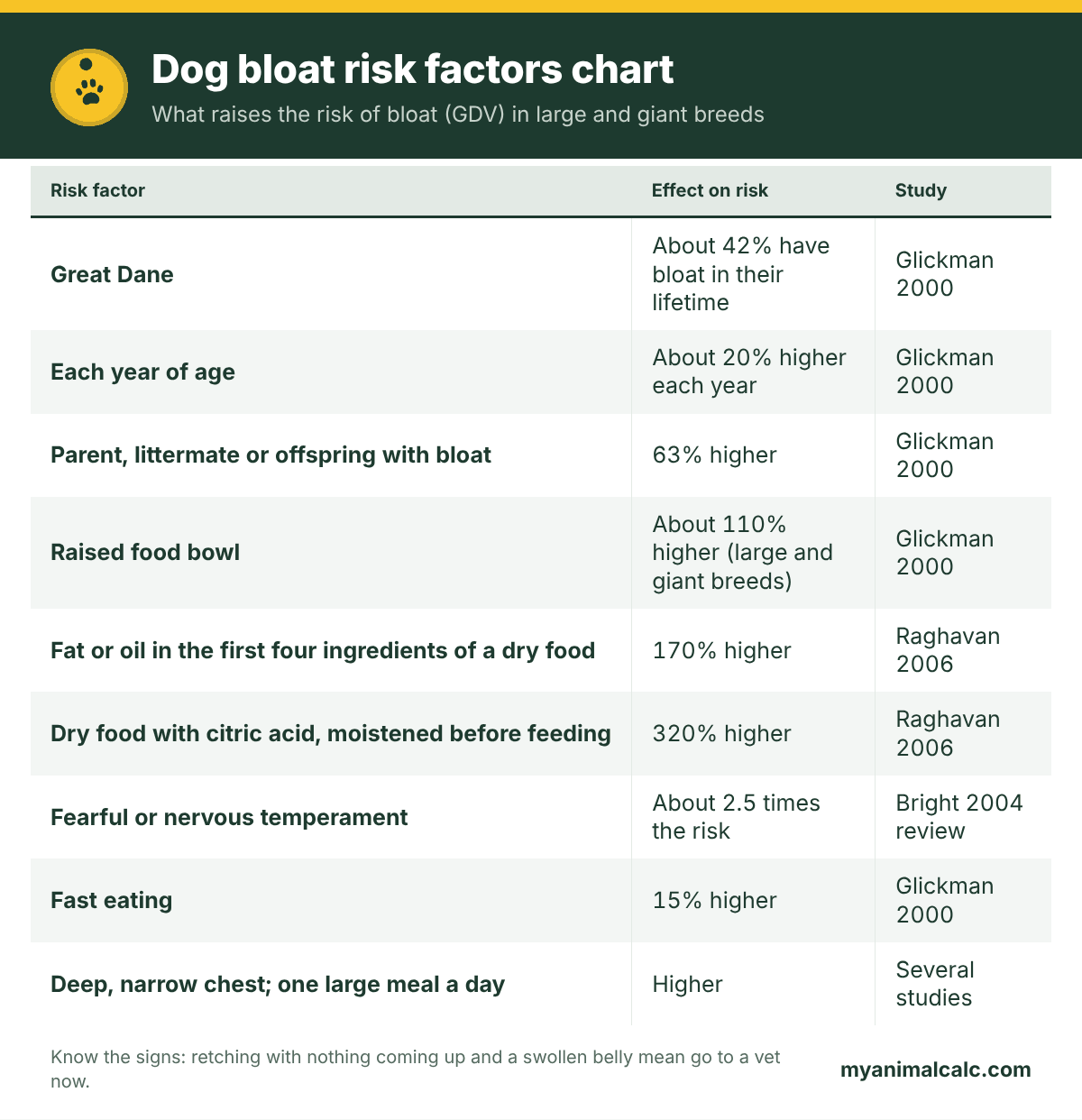
Dog bloat risk factors chart
What the main studies of large and giant breeds found. A higher figure means a bigger rise in risk.
| Risk factor | Effect on risk | Study |
|---|---|---|
| Great Dane | About 42% have bloat in their lifetime | Glickman 2000 |
| Each year of age | About 20% higher each year | Glickman 2000 |
| Parent, littermate or offspring with bloat | 63% higher | Glickman 2000 |
| Raised food bowl | About 110% higher (large and giant breeds) | Glickman 2000 |
| Fat or oil in the first four ingredients of a dry food | 170% higher | Raghavan 2006 |
| Dry food with citric acid, moistened before feeding | 320% higher | Raghavan 2006 |
| Fearful or nervous temperament | About 2.5 times the risk | Bright 2004 review |
| Fast eating | 15% higher | Glickman 2000 |
| Deep, narrow chest; one large meal a day | Higher | Several studies |
The figures come from studies of large and giant breeds, so they show which habits matter, not your own dog’s exact chance of bloat.
Signs of bloat in dogs
The classic sign is retching or trying to vomit with little or nothing coming up. The belly swells and feels tight, and may sound hollow when tapped. Dogs are restless, pace, drool, look at their side or stand stretched out, and then grow weak with pale gums and fast breathing as shock sets in. Bloat often starts within a few hours of a meal, and many cases begin in the evening or at night. Any of these signs in a large, deep-chested dog means going to a vet now.
Breeds at risk of dog bloat
Large and giant breeds with deep, narrow chests are most at risk. The Great Dane tops every list, followed by breeds such as the Weimaraner, Saint Bernard, Gordon and Irish Setters, Standard Poodle, Bloodhound, Irish Wolfhound, Akita, German Shepherd, Boxer and Doberman. Medium and small deep-chested dogs, including Basset Hounds and some Dachshunds, can bloat too, so knowing the signs matters for every owner.
How to lower the risk of dog bloat
Feed two or three smaller meals instead of one big one, and slow fast eaters with a slow-feeder bowl, a puzzle feeder or by spreading kibble on a tray. Feed from the floor rather than a raised bowl unless your vet has a reason to raise it. Feed dogs apart if they compete at the bowl. Choose a food without fat or oil among the first four ingredients if your dog is a high-risk breed, and avoid hard exercise for an hour or so around meals.
Preventive gastropexy
A gastropexy stitches the stomach to the body wall so it cannot twist. Vets often suggest it for Great Danes and other high-risk breeds, and it can be done at the same time as spaying or neutering, sometimes with keyhole surgery. It does not stop the stomach filling with gas, so a dog that has had one still needs a vet if it shows signs of bloat, but it makes the deadly twist very unlikely.
Printable dog bloat chart
The chart above as an image, to save on your phone or print for the fridge. Use the calculator at the top of the page for your own dog.
If your dog is retching or vomiting, the dog vomiting calculator helps you judge how urgent it is. To split the day’s food into smaller meals, use the dog food calculator.
Dog bloat FAQs
What are the first signs of bloat in a dog?
Restlessness and pacing, drooling, and retching or trying to vomit with little or nothing coming up, followed by a swollen, tight belly. Go to a vet at once; do not wait to see if it passes.
How long can a dog live with bloat?
Not long. Untreated bloat with a twisted stomach can be fatal within one to two hours, which is why it is always an emergency.
Can a dog with bloat still poop or burp?
Sometimes, early on, which can be misleading. Retching without bringing anything up and a swelling belly matter more than whether your dog has pooped.
Do raised food bowls cause bloat?
In a large study of large and giant breeds, eating from a raised bowl was linked to about 110% higher risk. Feed from the floor unless your vet advises a raised bowl for another reason.
Which dogs get bloat the most?
Large and giant deep-chested breeds, above all the Great Dane, which has about a 42% lifetime risk. Weimaraners, Saint Bernards, Setters, Standard Poodles and German Shepherds are also at high risk.
Does wetting dry food prevent bloat?
Not on its own. In one study, moistening a dry food that contained citric acid was linked to a higher risk. Smaller meals, slower eating and a floor-level bowl are better-supported steps.
Sources
- Glickman et al. (2000), JAVMA: Non-dietary risk factors for gastric dilatation-volvulus in large and giant breed dogs
- Veterinary Information Network (Bell, Tufts): Risk factors for canine bloat
- Purina Institute: Canine gastric dilatation-volvulus (PDF)
- Bright (2004), WSAVA Congress: GDV risk factors and minimally invasive gastropexy