| Usually minor | One vomit in a bright dog that is eating and drinking |
|---|---|
| See a vet today | More than two vomits in 24 hours, or for more than a day or two |
| Emergency | Retching with nothing coming up, poison, pale gums, a vomiting puppy with diarrhea |
| Blood | Red, or brown like coffee grounds: see a vet |
| At home | Small sips of water often, then a small plain meal |
How to use the dog vomiting calculator
- Enter how many times your dog has vomited in the last 24 hours and how long it has been going on.
- Choose what came up: food, yellow bile, clear liquid, grass, blood or an object.
- Tick any other signs, such as tiredness, belly pain, diarrhea or a swollen belly.
- Read the urgency level and what to do next, with links for poisoning and dehydration.
Dog vomiting chart for when to call the vet
How urgent common vomiting situations are for an adult dog. Puppies, seniors and dogs with ongoing illness need help sooner.
| Situation | What to do |
|---|---|
| One vomit, dog bright and eating | Watch at home |
| Two vomits in 24 hours | Call your vet |
| More than two vomits in 24 hours | See a vet today |
| Vomiting for more than a day or two | See a vet today |
| Blood, or brown bits like coffee grounds | See a vet today; now if weak |
| Can’t keep water down | See a vet today |
| May have swallowed a toy, sock or bone | See a vet today; now if vomiting repeats |
| Puppy vomiting, with diarrhea or tiredness | Go to a vet now |
| Retching with nothing coming up, swollen belly | Go to a vet now |
| May have eaten a poison or medicine | Call a poison line or vet now |
| Pale or yellow gums, collapse | Go to a vet now |
If you are not sure, call your vet. Describing what came up and how often helps them decide how soon to see your dog.
What the color of dog vomit means
The color gives a clue, but not a diagnosis.
| Color | What it can mean |
|---|---|
| Yellow (bile) | An empty stomach; common in the morning |
| White foam | An empty or irritated stomach |
| Clear liquid | Water or saliva, often after drinking fast |
| Undigested food | Vomiting soon after eating, or regurgitation |
| Red or brown like coffee grounds | Blood: see a vet |
| Green | Grass, or bile |
Vomiting or regurgitation
Vomiting is active: the belly heaves and food or liquid is pushed up from the stomach, often after drooling and licking the lips. Regurgitation is passive: undigested food or water slides out with little effort, often right after eating, sometimes in a tube shape. Regurgitation points to the esophagus rather than the stomach, so tell your vet which one you saw. A video on your phone helps.
Home care for mild dog vomiting
For a single vomit in a dog that is otherwise well, offer small amounts of water often rather than a full bowl. After a few hours without more vomiting, give a small portion of its normal food or a plain meal such as cooked chicken and rice, then build back up over a day. Ask your vet before holding back food from a puppy, a toy breed or a diabetic dog. Never give human anti-nausea or pain medicines, and only make a dog vomit if a vet tells you to (see the hydrogen peroxide calculator).
When dog vomiting is an emergency
Go to a vet now if your dog retches without bringing anything up and its belly swells, which can be bloat; if it may have eaten a poison, medicine or toxic food; if its gums are pale or yellow; or if a puppy vomits repeatedly with diarrhea or tiredness, because parvovirus is a risk. In the US, call the ASPCA Animal Poison Control Center on (888) 426-4435 or the Pet Poison Helpline on (855) 764-7661 (a fee may apply), or your nearest emergency vet.
Printable dog vomiting chart
The chart above as an image, to save on your phone or print for the fridge. Use the calculator at the top of the page for your own dog.
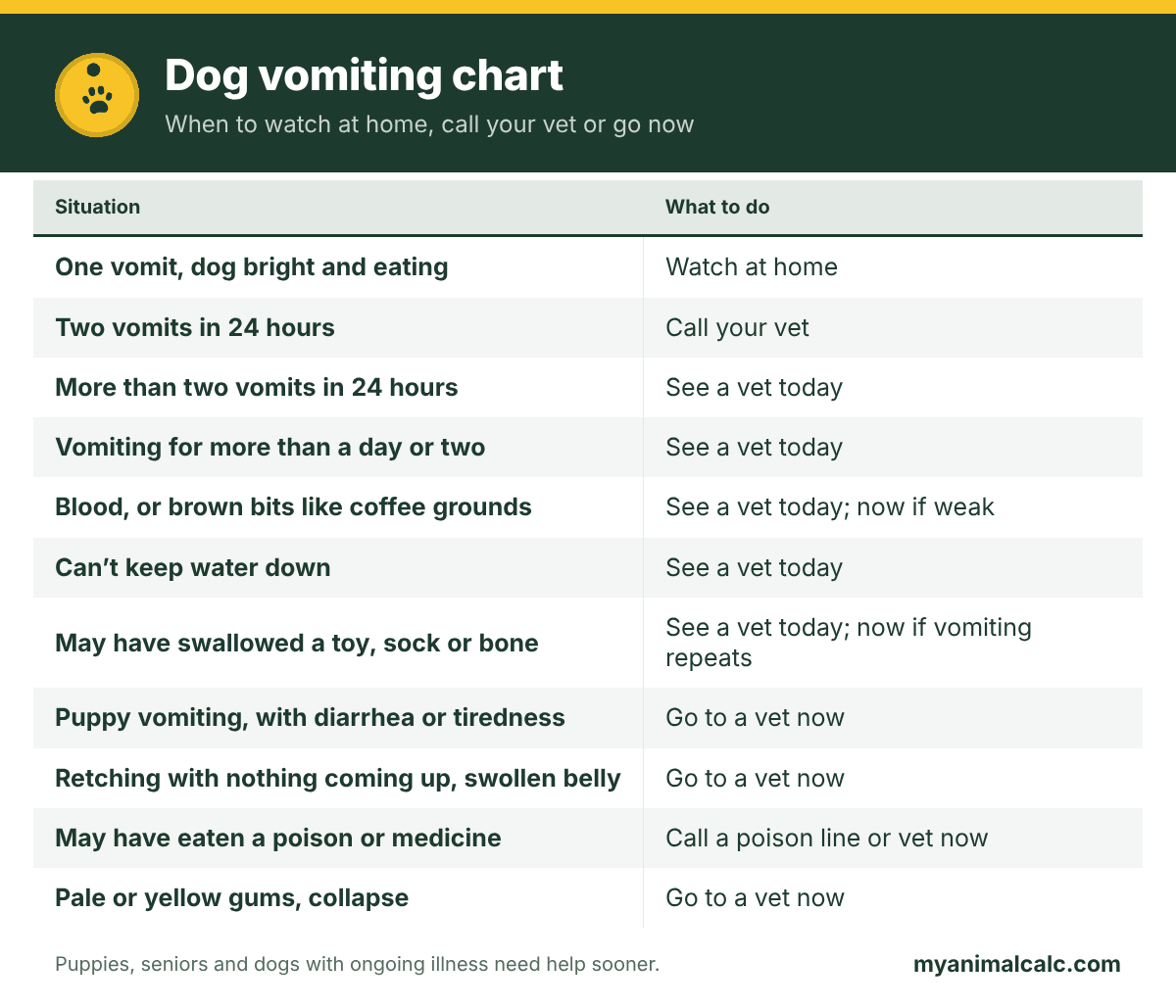
For bloat signs, see the dog bloat risk calculator. With diarrhea too, check the dog poop color calculator and the dog dehydration calculator.
Dog vomiting FAQs
When should I worry about my dog vomiting?
When it vomits more than twice in 24 hours, for more than a day or two, with blood, or with tiredness, belly pain, diarrhea or not eating. Retching with nothing coming up, poisoning and pale gums are emergencies.
Why is my dog throwing up yellow?
Yellow vomit is bile, usually from an empty stomach, often in the morning. If it happens once and your dog is fine, a small late-evening meal may help. If it keeps happening or comes with other signs, see your vet.
Why is my dog throwing up white foam?
White foam usually means an empty or irritated stomach. Once is often minor. Repeated foamy retching with little coming up, especially with a swollen belly, can be bloat and needs a vet now.
Should I feed my dog after it vomits?
Wait a few hours, offering small sips of water, then give a small plain meal. Ask your vet first for puppies, toy breeds and diabetic dogs, which should not go long without food.
Can I give my dog Pepto-Bismol for vomiting?
Only if your vet says so. It contains a salicylate related to aspirin and turns poop black, which can hide bleeding. Your vet can prescribe a dog anti-nausea medicine instead.
Is it normal for a dog to vomit once?
Yes, an occasional single vomit is common, for example after eating grass or eating too fast. Watch your dog for the next day and call your vet if it happens again.