| AAFCO range | Calcium 1 to 2 times the phosphorus |
|---|---|
| Adult minimum | 1.25 g calcium and 1.0 g phosphorus per 1,000 kcal |
| Puppy minimum | 3.0 g calcium and 2.5 g phosphorus per 1,000 kcal |
| Calcium carbonate | 40% calcium: 1 g gives 400 mg |
| Eggshell powder | About 38% calcium: 1 g gives about 380 mg |
How to use the dog calcium to phosphorus ratio calculator
- Enter your dog’s weight and life stage, or the day’s calories, so the calculator knows the calcium minimum.
- Enter the calcium and phosphorus in the whole day’s recipe, in mg.
- Choose a target ratio and the calcium source you use: calcium carbonate, eggshell powder, calcium citrate or another with its % calcium.
- Read the grams to add a day, and weigh them on a scale that reads to 0.01 g.
Dog calcium to phosphorus ratio chart
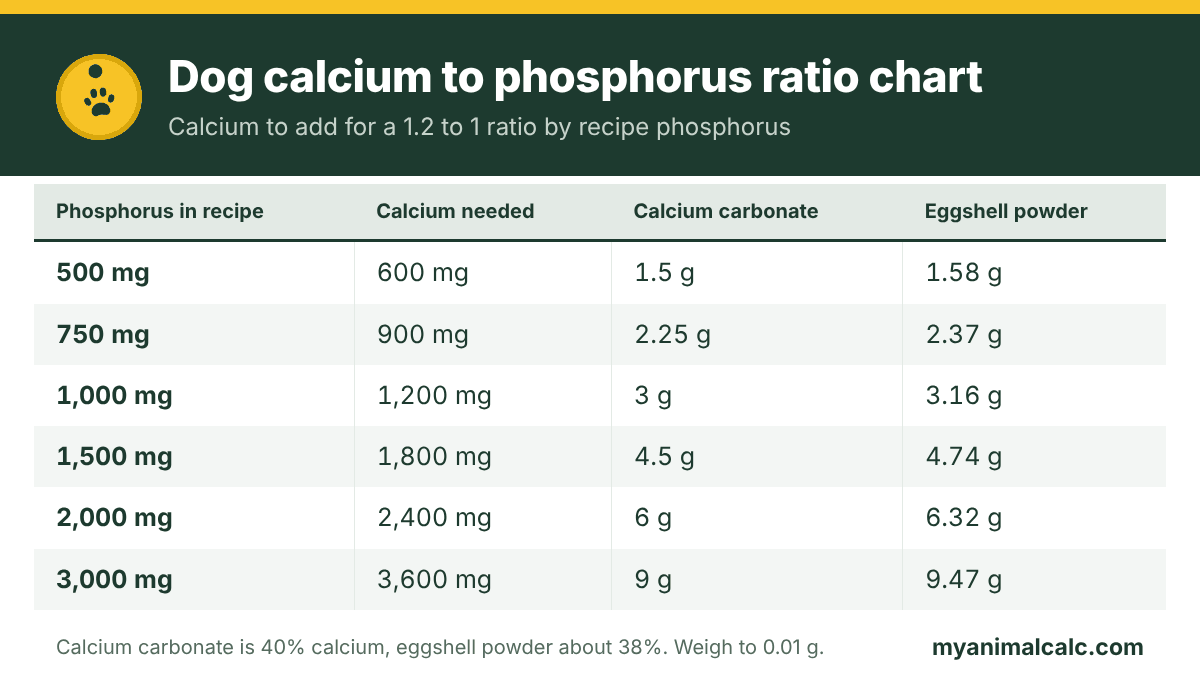
Calcium needed for a 1.2 to 1 ratio at common amounts of phosphorus in a day’s recipe, assuming the recipe has almost no calcium of its own.
| Phosphorus in recipe | Calcium needed | Calcium carbonate | Eggshell powder |
|---|---|---|---|
| 500 mg | 600 mg | 1.5 g | 1.58 g |
| 750 mg | 900 mg | 2.25 g | 2.37 g |
| 1,000 mg | 1,200 mg | 3 g | 3.16 g |
| 1,500 mg | 1,800 mg | 4.5 g | 4.74 g |
| 2,000 mg | 2,400 mg | 6 g | 6.32 g |
| 3,000 mg | 3,600 mg | 9 g | 9.47 g |
Subtract whatever calcium the recipe already has; the calculator does this for you. Check that the total stays under the AAFCO maximum for your dog’s calories.
Why the dog calcium to phosphorus ratio matters
Dogs need calcium and phosphorus together for bones, teeth, nerves and muscles. When a diet has far more phosphorus than calcium, the body pulls calcium from the skeleton to keep blood levels steady. In puppies this can cause soft, bent and fractured bones within weeks, a condition called nutritional secondary hyperparathyroidism. In adults it develops more slowly. Too much calcium is also harmful, above all for large-breed puppies, whose bones and joints grow abnormally on excess calcium.
Calcium sources for home-cooked dog food
Calcium carbonate powder is cheap, plain and 40% calcium. Home-made eggshell powder is about 38% calcium; bake clean shells at about 300°F (150°C) for 10 minutes and grind them to a fine powder. Calcium citrate is only 21% calcium, so it takes about twice as much. Bone meal contains phosphorus as well as calcium, so it changes the ratio less than its calcium content suggests; use the label values. Avoid antacid tablets with added flavors or sweeteners.
Balancing the rest of the recipe
Fixing calcium doesn’t make a recipe complete. Home-made diets are often short of zinc, iron, copper, iodine, vitamin D, vitamin E and choline as well. Check them with the dog mineral requirements calculator and the dog vitamin requirements calculator, or ask a board-certified veterinary nutritionist for a balanced recipe, especially for a puppy or a dog with kidney disease, whose phosphorus needs to be lower.
Printable dog calcium to phosphorus ratio chart
The chart above as an image, to save on your phone or print. Use the calculator at the top of the page for your own dog.
Plan portions for home-made food with the raw dog food calculator and check calories with the dog calorie calculator.
Dog calcium to phosphorus ratio FAQs
What is the ideal calcium to phosphorus ratio for dogs?
AAFCO allows 1:1 to 2:1. Many home-made recipes aim for about 1.2 to 1.4 to 1.
How much eggshell powder do I add to homemade dog food?
About 2.6 g per 1,000 mg of calcium needed. For a recipe with 1,000 mg phosphorus and no calcium, that is about 3.2 g a day for a 1.2 to 1 ratio.
How much calcium carbonate do I add to dog food?
Calcium carbonate is 40% calcium, so 2.5 g gives 1,000 mg of calcium. The calculator works out the exact amount for your recipe.
Does raw meaty bone give enough calcium?
Raw meaty bones supply calcium and phosphorus together, and many raw diets use them instead of a supplement, but the ratio depends on how much bone is fed. Splinters and blockages are a risk with cooked bones.
Can I use a human calcium supplement?
A plain calcium carbonate or citrate powder is fine. Avoid tablets with vitamin D, sweeteners or flavors, and never use ones with xylitol.
Does my dog need calcium if it eats commercial food?
No. Complete and balanced foods already have the right amount; adding more can do harm.