| By week 3 | About half of food-allergic dogs are less itchy |
|---|---|
| By week 5 | About 80 to 85% have improved |
| By week 8 | Over 90% have improved |
| Slow responders | Under 5% need up to 13 weeks |
| Food challenge | Over 90% flare within 14 days |
How to use the dog elimination diet calculator
- Enter the day the new diet starts, after the switch-over from the old food is complete.
- Choose the diet: hydrolyzed, novel protein prescription or home-cooked.
- Choose the main signs and the trial length: 8 weeks suits most dogs, 12 for slow responders.
- Read the timeline and put the check dates in your calendar.
Dog elimination diet timeline chart
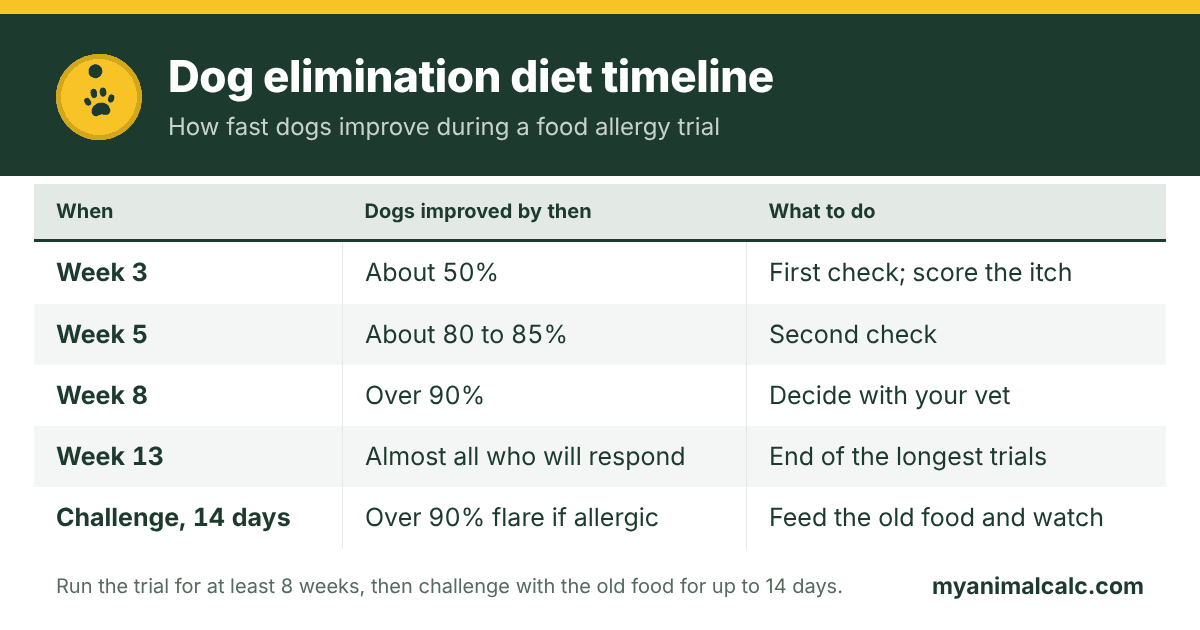
How quickly dogs with food-allergic skin disease improve on an elimination diet (Olivry, Mueller and Prélaud 2015), and what to do at each point.
| When | Dogs improved by then | What to do |
|---|---|---|
| Week 3 | About 50% | First check; score the itch |
| Week 5 | About 80 to 85% | Second check |
| Week 8 | Over 90% | Decide with your vet |
| Week 13 | Almost all who will respond | End of the longest trials |
| Challenge, 14 days | Over 90% flare if allergic | Feed the old food and watch |
The challenge is what confirms a food allergy. Many itchy dogs improve during a trial for other reasons, such as the season changing or flea control.
Choosing a dog elimination diet
A hydrolyzed diet breaks proteins into pieces too small for the immune system to recognize, so it works even when you don’t know what your dog has eaten before. A novel protein diet uses a protein your dog has never had, such as kangaroo, rabbit or venison. Prescription versions are made on lines kept free of other proteins. Over-the-counter “limited ingredient” foods are not suitable: studies have found proteins in them that are not on the label.
Rules during the trial
For the whole trial your dog eats the trial diet and water, and nothing else. That means no treats, chews, table scraps, flavored toothpaste, or pill pockets. Monthly flavored heartworm and flea chews contain protein, so ask your vet for an unflavored option. Everyone in the house needs to know the rules, and dogs that steal food or eat outdoors need watching. A single slip can mean restarting the clock, so keep a log of anything your dog ate by mistake.
The food challenge and finding the trigger
If your dog improves, feed the old food again. Olivry and Mueller found that over 90% of food-allergic dogs flare within 14 days, many within a few days. A flare confirms the allergy. Go back to the trial diet until the signs settle, then add single ingredients one at a time, such as chicken, beef or wheat, each for up to 2 weeks. The usual culprits in dogs are beef, dairy, chicken and wheat, but any protein can be one.
Printable dog elimination diet timeline chart
The chart above as an image, to save on your phone or print. Use the calculator at the top of the page for your own dog.
Switch foods gradually with the dog food transition calculator, and for itching your vet may also use the drug in the Apoquel dosage for dogs calculator.
Dog elimination diet FAQs
How long does an elimination diet take for dogs?
At least 8 weeks, which is enough for over 90% of food-allergic dogs to improve. A few need up to 13 weeks.
Can I give treats during an elimination diet?
Only treats made from the trial diet itself, such as kibble from the same bag or prescription treats from the same line.
Are dog food allergy blood tests accurate?
No. Blood, saliva and hair tests don’t reliably diagnose food allergy in dogs; the elimination diet and challenge do.
What happens after the elimination diet?
If your dog improved, you feed the old food again for up to 14 days. A flare confirms the allergy; then you test single foods one at a time.
Is grain a common allergy in dogs?
Less than people think. Beef, dairy and chicken are reported more often than wheat or other grains.
Can a home-cooked diet be used for the trial?
Yes, with one new protein and one carbohydrate, but it isn’t complete, so ask your vet or a veterinary nutritionist to balance it for longer trials or for puppies.