| Adult minimum (AAFCO) | 45 g per 1,000 kcal (18% of dry matter) |
|---|---|
| Puppies and mothers (AAFCO) | 56.3 g per 1,000 kcal (22.5% of dry matter) |
| NRC allowance, adults | 25 g per 1,000 kcal of highly digestible protein |
| Example | A 40 lb spayed or neutered dog: at least 44 g a day |
| Senior dogs | Usually as much protein or more, not less, unless a vet advises otherwise |
How to use the dog protein calculator
- Enter your dog’s weight.
- Choose the life stage and activity, or puppy with its age in months.
- Optional: enter the crude protein % and kcal per kg from your dog food label.
- Read the result: the minimum grams of protein a day, the NRC allowance, and what your food provides.
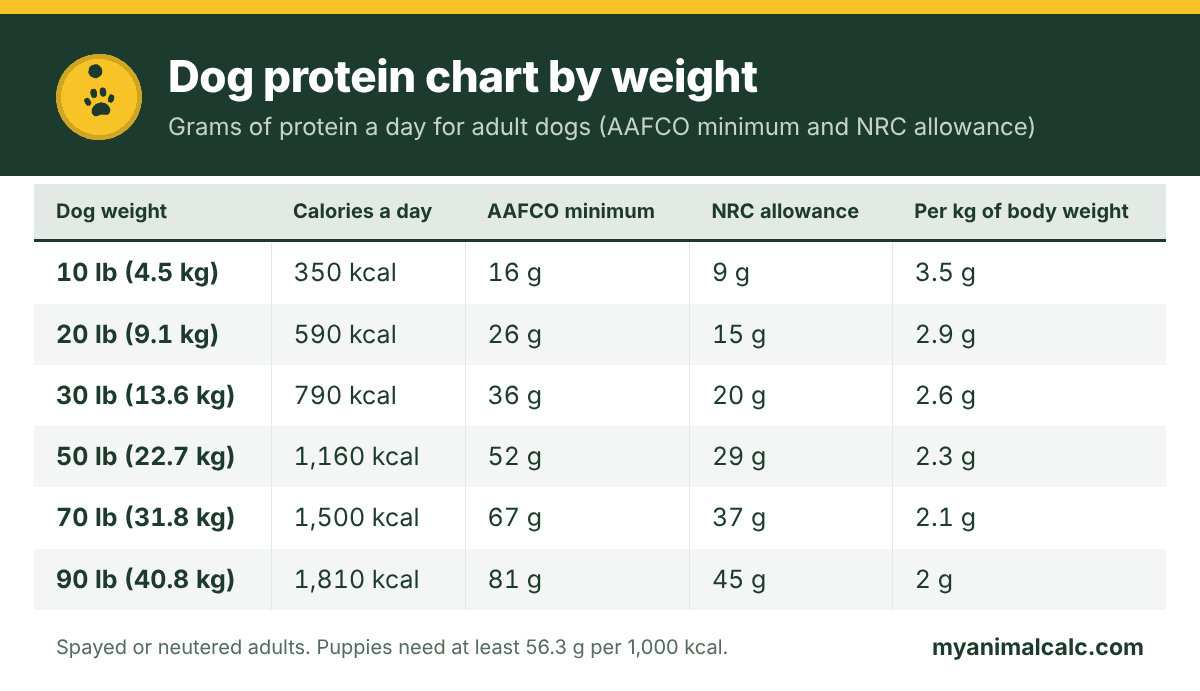
Dog protein chart by weight
Daily protein for spayed or neutered adult dogs from the AAFCO minimum and the NRC recommended allowance.
| Dog weight | Calories a day | AAFCO minimum | NRC allowance | Per kg of body weight |
|---|---|---|---|---|
| 10 lb (4.5 kg) | 350 kcal | 16 g | 9 g | 3.5 g |
| 20 lb (9.1 kg) | 590 kcal | 26 g | 15 g | 2.9 g |
| 30 lb (13.6 kg) | 790 kcal | 36 g | 20 g | 2.6 g |
| 50 lb (22.7 kg) | 1,160 kcal | 52 g | 29 g | 2.3 g |
| 70 lb (31.8 kg) | 1,500 kcal | 67 g | 37 g | 2.1 g |
| 90 lb (40.8 kg) | 1,810 kcal | 81 g | 45 g | 2 g |
The NRC allowance assumes very digestible protein; the AAFCO minimum leaves a margin for the protein quality in real foods, which is why it is higher.
How much protein does a dog need per kg?
For an average spayed or neutered adult, the AAFCO minimum works out to about 2 to 3.5 g of protein per kg of body weight a day, more for small dogs than large ones because small dogs eat more calories for their size. Active and working dogs eat more calories, so they get more protein from the same food.
Protein for puppies, pregnant and nursing dogs
Growth, pregnancy and milk production all need more protein per calorie: at least 56.3 g per 1,000 kcal, the AAFCO minimum for growth and reproduction. Choosing a complete food labelled for growth or all life stages covers this, as long as the puppy or mother eats enough of it.
Protein for senior dogs and dogs with kidney disease
Healthy older dogs don’t need less protein; many need as much or more to keep their muscle, so cutting protein just because a dog is old isn’t advised. Dogs with kidney disease are different: kidney diets limit phosphorus and adjust protein, and the amount depends on the stage of the disease, so follow your vet’s plan.
Checking dog protein on a food label
To check a food, convert its protein to grams per 1,000 kcal: protein % × 10 × 1,000 ÷ kcal per kg. A kibble with 26% protein and 3,600 kcal per kg gives 72 g per 1,000 kcal, well above the adult minimum of 45. Comparing per 1,000 kcal works for wet and dry foods alike; the dog food dry matter calculator shows the dry matter percentages too.
Printable dog protein chart
The chart above as an image, to save on your phone or print. Use the calculator at the top of the page for your own dog.
The protein figure depends on the calories your dog eats; see the dog calorie calculator. To estimate a food’s calories from its label, use the dog food kcal calculator.
Dog protein FAQs
How much protein does a dog need a day?
At least 45 g per 1,000 kcal it eats. A 40 lb spayed or neutered adult eating about 980 kcal needs at least 44 g of protein a day; a 10 lb dog about 16 g.
What percentage of protein should dog food have?
At least 18% on a dry matter basis for adults and 22.5% for puppies and mothers. On the label (as fed), a kibble with 10% moisture needs at least about 16% protein; a canned food much less, because it is mostly water.
Do senior dogs need less protein?
No, not if they are healthy. Older dogs tend to lose muscle and often benefit from as much or more protein. Only dogs with certain diseases, such as kidney disease, need it adjusted, and your vet will guide that.
Is high-protein dog food better?
Not necessarily. Once a food meets your dog’s needs, extra protein is used for energy. It suits active dogs and some dogs on a diet, but the right food depends on your dog.
How do I work out protein per 1,000 kcal?
Multiply the crude protein % by 10 to get grams per kg of food, then divide by the kcal per kg and multiply by 1,000.
Can too much protein damage a dog’s kidneys?
There is no good evidence that high-protein diets harm the kidneys of healthy dogs. Dogs that already have kidney disease need a diet planned by their vet.