| Dry matter % | 100 − moisture % |
|---|---|
| Nutrient on a dry matter basis | Label % ÷ dry matter % × 100 |
| Example | Canned food, 8% protein and 78% moisture: 8 ÷ 22 × 100 = 36.4% protein |
| AAFCO minimum, adults | 18% protein and 5.5% fat, dry matter |
| AAFCO minimum, puppies and mothers | 22.5% protein and 8.5% fat, dry matter |
How to use the dog food dry matter calculator
- Find the guaranteed analysis on the bag or can.
- Enter the protein, fat, fiber and moisture, and the ash if it is printed.
- Choose the life stage to compare with the AAFCO minimums.
- Read the dry matter figures for protein, fat, fiber, ash and carbohydrate.
Dog food dry matter examples for wet and dry food
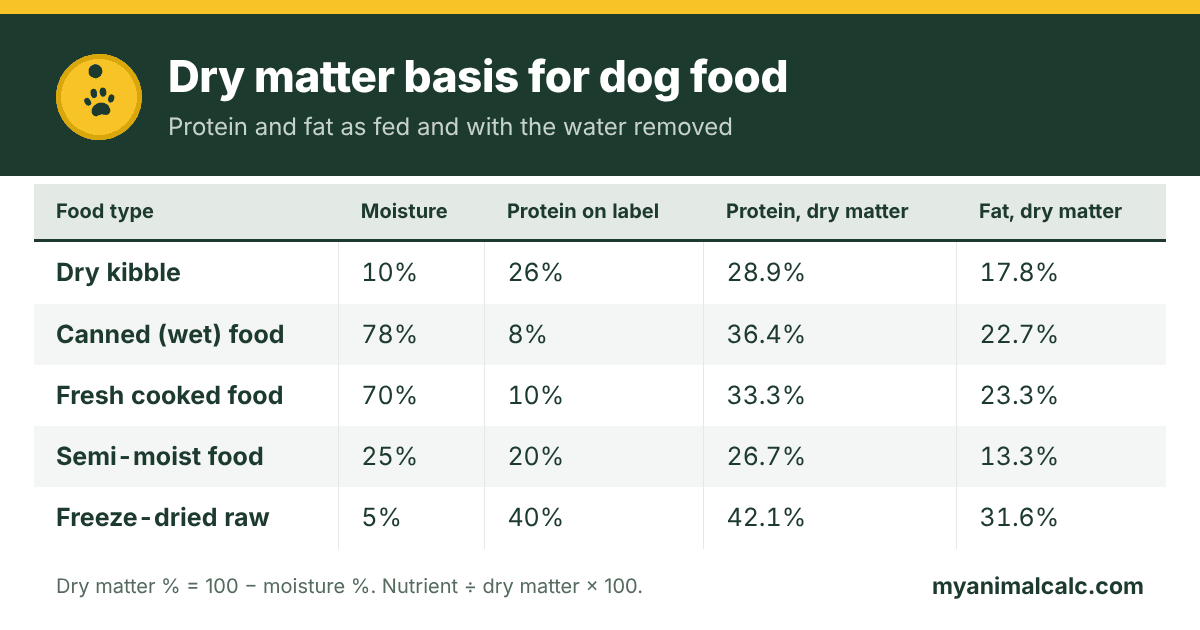
Typical label figures for five kinds of dog food, converted to a dry matter basis. Notice how the order changes once the water is removed.
| Food type | Moisture | Protein on label | Protein, dry matter | Fat, dry matter |
|---|---|---|---|---|
| Dry kibble | 10% | 26% | 28.9% | 17.8% |
| Canned (wet) food | 78% | 8% | 36.4% | 22.7% |
| Fresh cooked food | 70% | 10% | 33.3% | 23.3% |
| Semi-moist food | 25% | 20% | 26.7% | 13.3% |
| Freeze-dried raw | 5% | 40% | 42.1% | 31.6% |
How to calculate dry matter basis by hand
Take the moisture from the guaranteed analysis away from 100 to get the dry matter. Then divide each nutrient by the dry matter and multiply by 100. For a kibble with 10% moisture and 26% protein, the dry matter is 90% and the protein on a dry matter basis is 26 ÷ 90 × 100 = 28.9%. For a canned food with 78% moisture and 8% protein, it is 8 ÷ 22 × 100 = 36.4%.
How to estimate carbohydrates in dog food
Labels don’t list carbohydrates, but you can estimate them by difference: 100 minus protein, fat, fiber, moisture and ash. If the ash isn’t printed, the calculator assumes about 7% for dry food and 2.5% for wet food. Convert the result to dry matter in the same way to compare the carbohydrate in wet and dry foods.
Limits of the guaranteed analysis
The guaranteed analysis gives minimums for protein and fat and maximums for fiber and moisture, not exact amounts, so the real food can contain a little more protein or less water than the label says. For the most exact comparison, ask the maker for the typical analysis or compare nutrients per 1,000 kcal: the dog food kcal calculator estimates the calories and the dog protein calculator checks protein per 1,000 kcal.
Printable dog food dry matter chart
The chart above as an image, to save on your phone or print. Use the calculator at the top of the page for your own dog.
Choosing between foods? The dog food cost calculator compares what they cost to feed, and the dog food transition calculator plans the switch.
Dog food dry matter FAQs
What is dry matter basis in dog food?
The share of each nutrient once all the water is removed. It lets you compare foods with different moisture, such as canned food and kibble, on equal terms.
How do I compare wet and dry dog food?
Convert both labels to a dry matter basis: divide each nutrient by (100 − moisture) and multiply by 100. Then compare the dry matter figures, or compare per 1,000 kcal.
What protein percentage should dog food have on a dry matter basis?
At least 18% for adult dogs and 22.5% for puppies, pregnant and nursing dogs, the AAFCO minimums. Most complete foods are well above these levels.
Why does canned dog food look so low in protein?
Because it is mostly water. A canned food with 8% protein and 78% moisture is 36.4% protein on a dry matter basis, more than many kibbles.
What is ash in dog food?
Ash is the mineral content, such as calcium and phosphorus, left when a food is burned in a lab. It isn’t an added ingredient.
Is a higher dry matter percentage better?
No. Dry matter only tells you how much of the food isn’t water. What matters is the nutrients in that dry matter and the calories.