| Bromethalin 0.01% | Toxic from about 0.24 mg/kg; deaths from about 0.95 mg/kg; no antidote |
|---|---|
| Brodifacoum 0.005% | Toxic from about 0.02 mg/kg; bleeding 3 to 7 days later |
| Cholecalciferol 0.075% | Signs from 0.1 mg/kg; kidney damage above 0.5 mg/kg |
| Toxic dose rule | One-tenth of the lowest reported lethal dose |
| Unknown bait | Treat as dangerous; take the package or a photo to the vet |
| What to do | Call your vet or a poison line now |
How to use the dog rat poison toxicity calculator
- Enter your dog’s weight.
- Find the active ingredient on the package or bait station, and pick it with its percentage.
- Enter how much bait is missing, in grams or ounces. Weigh a spare block if you can, and assume the most that could be gone.
- Read the dose in mg/kg and the risk, then call your vet or a poison line.
How much rat poison is toxic to dogs (chart by weight)
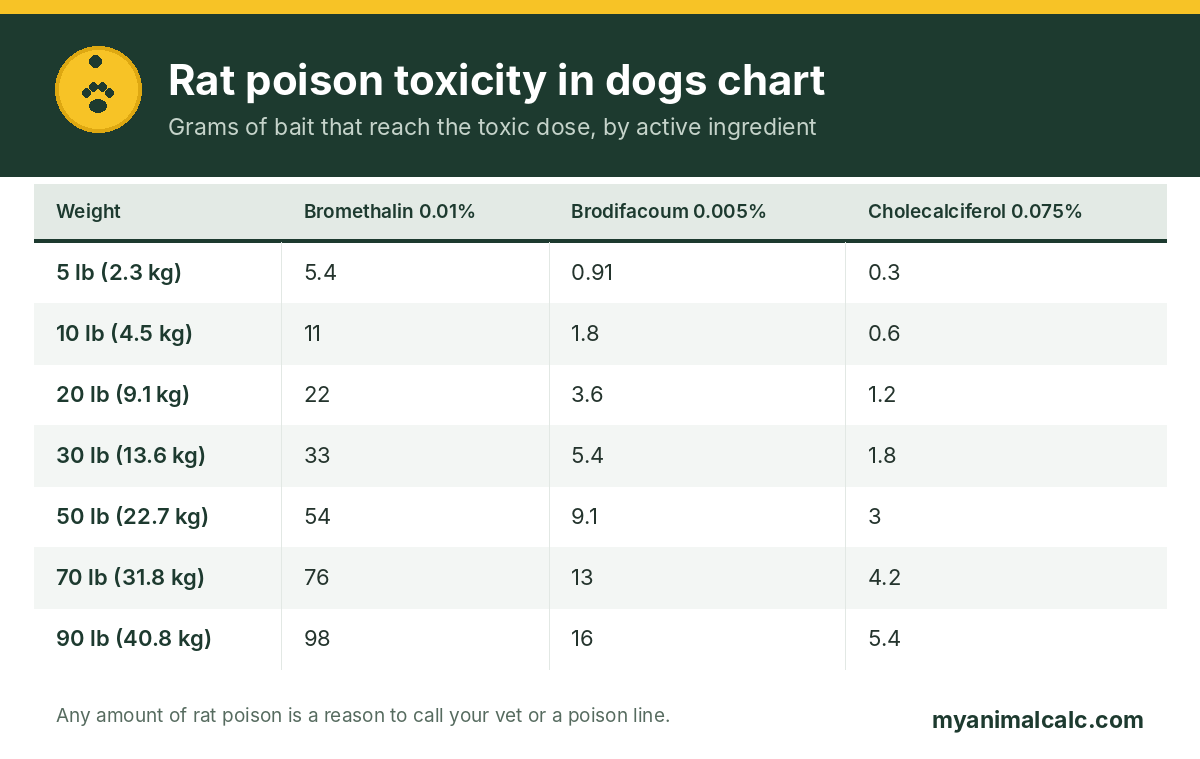
Grams of bait that reach the toxic dose for the three most common active ingredients, for dogs of common weights.
| Dog’s weight | Bromethalin 0.01% (g) | Brodifacoum 0.005% (g) | Cholecalciferol 0.075% (g) |
|---|---|---|---|
| 5 lb (2.3 kg) | 5.4 | 0.91 | 0.3 |
| 10 lb (4.5 kg) | 11 | 1.8 | 0.6 |
| 20 lb (9.1 kg) | 22 | 3.6 | 1.2 |
| 30 lb (13.6 kg) | 33 | 5.4 | 1.8 |
| 50 lb (22.7 kg) | 54 | 9.1 | 3 |
| 70 lb (31.8 kg) | 76 | 13 | 4.2 |
| 90 lb (40.8 kg) | 98 | 16 | 5.4 |
A single mouse bait often weighs 7 to 28 g, so even one bait can be a toxic dose for a small dog. Color and shape don’t tell you the ingredient.
Types of rat poison and how they affect dogs
Bromethalin is now the most common rat poison pets eat in the US. It damages the energy supply of nerve cells, causing brain and spinal cord swelling: tremors, seizures, wobbling or paralysis over 1 to 7 days, with no antidote. Anticoagulants (brodifacoum, bromadiolone, difethialone, diphacinone, warfarin) use up the clotting factors that need vitamin K, so bleeding starts 3 to 7 days later. Cholecalciferol raises calcium and damages the kidneys within 12 to 48 hours.
Symptoms of rat poison in dogs
Anticoagulants cause pale gums, weakness, coughing or breathing trouble, nosebleeds, bruising, blood in the urine or stool and a swollen belly from internal bleeding. Bromethalin causes tremors, hind-leg weakness, seizures and dullness. Cholecalciferol causes vomiting, thirst and weakness. In all three, a dog can look completely normal for the first day or more.
What to do if your dog ate rat poison
Call your vet or an animal poison line now: ASPCA (888) 426-4435 or Pet Poison Helpline (855) 764-7661 (a fee may apply). Bring the package or bait station, or a clear photo of the label with the active ingredient and its EPA registration number. Vets usually make the dog vomit within a few hours of eating it and give activated charcoal. Anticoagulant cases get vitamin K1 by mouth for about 4 weeks or clotting tests at 48 to 72 hours; bromethalin and cholecalciferol cases may need repeated charcoal and monitoring.
Printable dog rat poison toxicity chart
The chart above as an image, to save on your phone or print. Use the calculator at the top of the page for your own dog.
For vitamin D supplements, see the dog vitamin D toxicity calculator. Other common poisons: the dog antifreeze toxicity calculator and the dog xylitol toxicity calculator.
Dog rat poison toxicity FAQs
How much rat poison is toxic to a dog?
It depends on the active ingredient. For a 30 lb dog, about 33 g of 0.01% bromethalin bait or about 5 g of 0.005% brodifacoum bait reaches the toxic dose.
How long does rat poison take to affect a dog?
Cholecalciferol 12 to 48 hours, bromethalin 1 to 7 days, and anticoagulant bleeding usually 3 to 7 days.
Can I tell the poison from the color of the bait?
No. Colors and shapes are shared across brands and ingredients. Check the label or the EPA registration number.
Is vitamin K the antidote for all rat poisons?
No. Vitamin K1 only reverses anticoagulants. Bromethalin and cholecalciferol have no antidote, which is why fast decontamination matters.