| Target weight | Each body condition point below 5 is about 10% of body weight |
|---|---|
| Calories | What a dog of the target weight needs (RER × life stage factor) |
| Safe rate | 1 to 2% of body weight a week |
| Meals | 3 smaller meals a day |
| See a vet | First, and urgently for a body condition score of 1 or 2 |
How to use the dog weight gain calculator
- Enter your dog’s current weight.
- Set the target: pick the body condition score, or enter a target weight from your vet.
- Choose the life stage and activity, and add your food’s calories if you want the amount in cups, grams or cans.
- Read the plan: calories a day, time to the target and the expected weight every 2 weeks.
Dog weight gain chart by weight
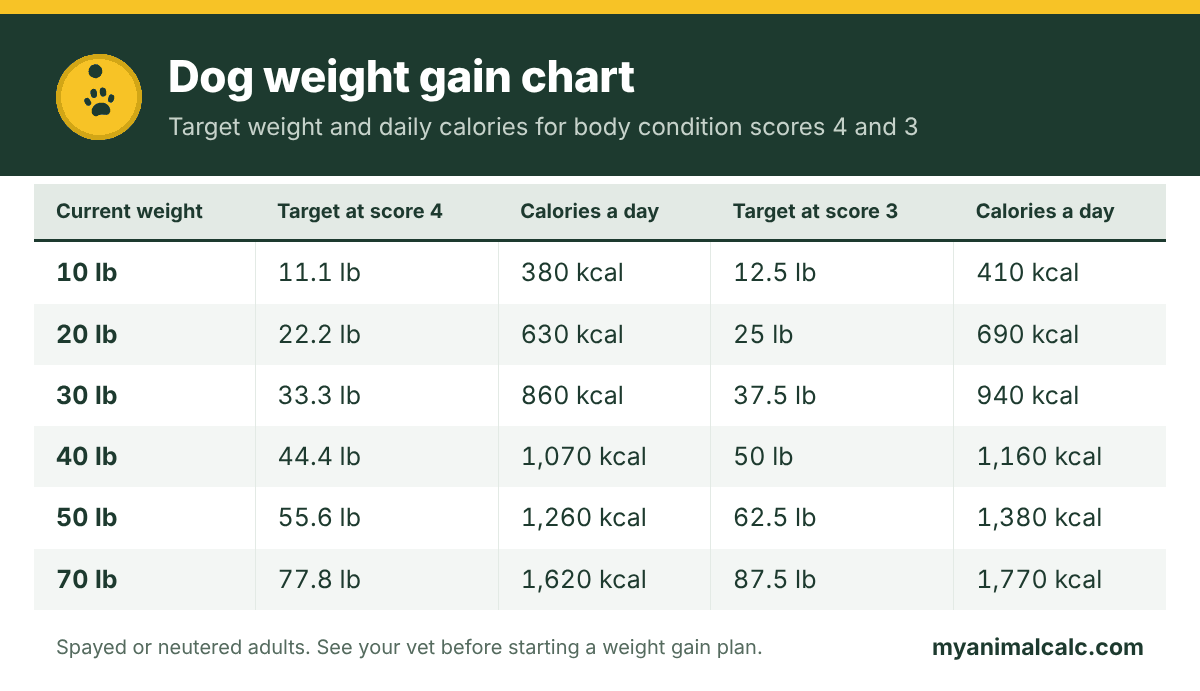
Target weights and daily calories for spayed or neutered adults with a body condition score of 4 (a little underweight) or 3 (thin).
| Current weight | Target at score 4 | Calories a day | Target at score 3 | Calories a day |
|---|---|---|---|---|
| 10 lb | 11.1 lb | 380 kcal | 12.5 lb | 410 kcal |
| 20 lb | 22.2 lb | 630 kcal | 25 lb | 690 kcal |
| 30 lb | 33.3 lb | 860 kcal | 37.5 lb | 940 kcal |
| 40 lb | 44.4 lb | 1,070 kcal | 50 lb | 1,160 kcal |
| 50 lb | 55.6 lb | 1,260 kcal | 62.5 lb | 1,380 kcal |
| 70 lb | 77.8 lb | 1,620 kcal | 87.5 lb | 1,770 kcal |
At 1.5% a week, a score 4 dog takes about 8 weeks to reach its target and a score 3 dog about 15 weeks.
Is my dog underweight?
Vets use a 9-point body condition score, where 4 and 5 are ideal. At a score of 3 the ribs are easy to feel with no fat over them and the top of the spine and hip bones start to show. At 2 the ribs, spine and hip bones are clearly visible, and at 1 the dog is emaciated, with no body fat and visible muscle loss. A dog with a score of 4 just needs a little more food; scores of 3 or less need a vet visit first.
Why dogs lose weight
A dog can lose weight because it gets too little food or too little energy from it: a portion that is too small, a low-calorie food, competition with another pet at the bowl, stress or more exercise. Just as often the cause is medical: dental pain, worms, diabetes, kidney or liver disease, poor digestion (such as exocrine pancreatic insufficiency or inflammatory bowel disease) or cancer. A dog that eats well but still loses weight needs a vet.
How to help a dog gain weight safely
Feed the calories the calculator gives, in three meals instead of two. A more calorie-dense complete food, such as a performance food or, for a short time and with your vet’s agreement, a puppy food, helps if your dog can’t eat larger portions. Warm wet food smells stronger and can tempt a fussy eater. Don’t add large amounts of fat at once, which can upset the stomach or trigger pancreatitis. Weigh your dog weekly and add about 10% more food if it isn’t gaining.
Refeeding a very thin dog
A dog that is emaciated or has gone without food for a long time must be refed slowly. Feeding a large amount straight away can cause dangerous shifts in blood minerals, known as refeeding syndrome. Vets start at a fraction of the target calories and build up over several days, often with blood tests, so let your vet manage the first week for a dog with a score of 1 or 2.
Printable dog weight gain chart
The chart above as an image, to save on your phone or print. Use the calculator at the top of the page for your own dog.
Once your dog reaches its target, the dog calorie calculator gives the amount to keep it there. Check how much protein it gets with the dog protein calculator.
Dog weight gain FAQs
How can I help my dog gain weight fast?
Aim for steady dog weight gain of 1 to 2% of body weight a week rather than fast gain, which adds fat rather than muscle and can upset the stomach. Feed for the target weight in three meals and weigh your dog weekly.
How many calories does my dog need to gain weight?
About as many as a dog of its target weight needs. For a 40 lb spayed dog with a body condition score of 4, the target is about 44.4 lb and the calories about 1,070 kcal a day.
What can I feed my dog to gain weight?
More of a complete food, a more calorie-dense complete food, or both. Small extras such as plain cooked chicken or egg can help appetite, but keep them under 10% of the calories so the diet stays balanced.
Is puppy food good for helping an adult dog gain weight?
It has more calories and protein per cup, so it can help for a few weeks, but ask your vet first, especially for older dogs or dogs with kidney problems.
How often should I weigh my dog during weight gain?
Once a week, on the same scale and at the same time of day. If your dog hasn’t gained in two weeks, add about 10% more food.
Why is my dog eating but not gaining weight?
Worms, poor digestion, diabetes, kidney or thyroid disease and other illnesses can all cause weight loss despite a good appetite. See your vet before simply feeding more.