| Usual dose | 5 to 10 mg/kg every 12 hours |
|---|---|
| Lyme disease | 10 mg/kg once a day for 4 weeks (ACVIM) |
| Forms | 50 and 100 mg capsules and tablets, syrup 50 mg per 5 mL |
| Prescription needed | Yes |
| How to give | With food, followed by water or a little food |
How to use the Doxycycline dosage for dogs calculator
- Enter your dog’s weight in pounds or kilograms, from a recent weigh-in.
- Choose what Doxycycline is prescribed for and the tablet, capsule or syrup you have.
- Type the dose on your label (optional) to check it against the usual range for your dog’s weight.
- Read the result: the mg per dose, how often, the daily total and how much of your tablet, capsule or syrup that is.
Doxycycline dosage for dogs chart by weight
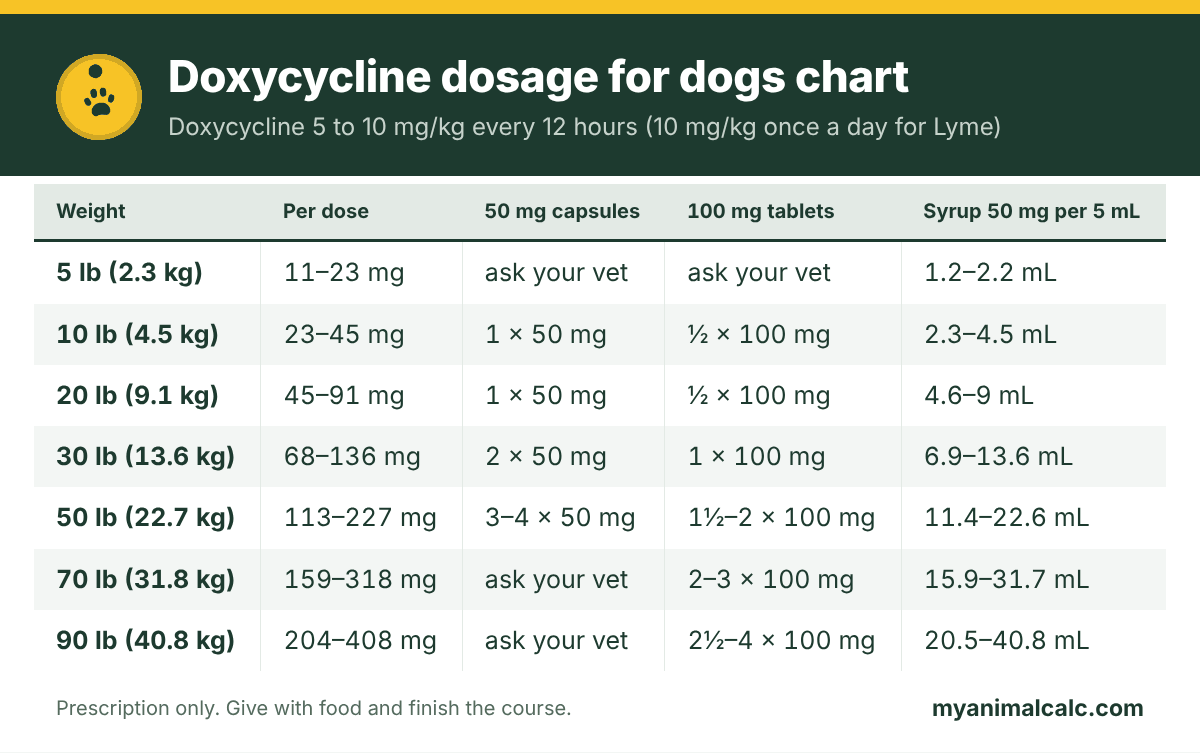
Doses at 5 to 10 mg/kg, given every 12 hours. For Lyme disease, switch the calculator to 10 mg/kg once a day.
| Weight | Per dose | 50 mg capsules | 100 mg tablets | Syrup 50 mg per 5 mL |
|---|---|---|---|---|
| 5 lb (2.3 kg) | 11–23 mg | ask your vet | ask your vet | 1.2–2.2 mL |
| 10 lb (4.5 kg) | 23–45 mg | 1 × 50 mg | ½ × 100 mg | 2.3–4.5 mL |
| 20 lb (9.1 kg) | 45–91 mg | 1 × 50 mg | ½ × 100 mg | 4.6–9 mL |
| 30 lb (13.6 kg) | 68–136 mg | 2 × 50 mg | 1 × 100 mg | 6.9–13.6 mL |
| 50 lb (22.7 kg) | 113–227 mg | 3–4 × 50 mg | 1½–2 × 100 mg | 11.4–22.6 mL |
| 70 lb (31.8 kg) | 159–318 mg | ask your vet | 2–3 × 100 mg | 15.9–31.7 mL |
| 90 lb (40.8 kg) | 204–408 mg | ask your vet | 2½–4 × 100 mg | 20.5–40.8 mL |
The 10 mg/kg Lyme dose once a day equals the top of this range given once instead of twice.
Doxycycline dosage for dogs per pound and per kg
The doxycycline dosage for dogs is 5 to 10 mg per kg, about 2.3 to 4.5 mg per pound, twice a day; for Lyme disease, 10 mg per kg (4.5 mg per pound) once a day. To work it out by hand, multiply your dog’s weight in pounds by 2.3 to 4.5 to get the mg of doxycycline, then round to the nearest piece your tablets can be split into.
Doxycycline dosage for dogs by weight, with examples
Here is what the Doxycycline dosage for dogs works out to at four common weights, rounded the same way as the calculator. These are the usual label or reference doses; the dose on your dog’s prescription comes first.
Doxycycline dosage for a 10 lb dog
A 10 lb (4.5 kg) dog usually gets:
- Most infections: 23–45 mg of doxycycline every 12 hours (1 × 50 mg capsule, ½ × 100 mg tablet or 2.3–4.5 mL of syrup at 10 mg/mL)
- Lyme disease: 45 mg of doxycycline once a day for 4 weeks (1 × 50 mg capsule, ½ × 100 mg tablet or 4.5 mL of syrup at 10 mg/mL)
Doxycycline dosage for a 25 lb dog
A 25 lb (11.3 kg) dog usually gets:
- Most infections: 57–113 mg of doxycycline every 12 hours (2 × 50 mg capsule, 1 × 100 mg tablet or 5.7–11.3 mL of syrup at 10 mg/mL)
- Lyme disease: 113 mg of doxycycline once a day for 4 weeks (2 × 50 mg capsule, 1 × 100 mg tablet or 11.3 mL of syrup at 10 mg/mL)
Doxycycline dosage for a 50 lb dog
A 50 lb (22.7 kg) dog usually gets:
- Most infections: 113–227 mg of doxycycline every 12 hours (3–4 × 50 mg capsule, 1½–2 × 100 mg tablet or 11.4–22.6 mL of syrup at 10 mg/mL)
- Lyme disease: 227 mg of doxycycline once a day for 4 weeks (2½ × 100 mg tablet or 22.7 mL of syrup at 10 mg/mL)
Doxycycline dosage for an 80 lb dog
An 80 lb (36.3 kg) dog usually gets:
- Most infections: 181–363 mg of doxycycline every 12 hours (2–3½ × 100 mg tablet or 18.2–36.2 mL of syrup at 10 mg/mL)
- Lyme disease: 363 mg of doxycycline once a day for 4 weeks (3½ × 100 mg tablet or 36.3 mL of syrup at 10 mg/mL)
What doxycycline treats in dogs
Doxycycline is the first choice for Lyme disease and for other tick-borne infections such as anaplasmosis and ehrlichiosis, and it is used for kennel cough and some other respiratory infections. For skin infections, AAHA lists it as a second-tier drug, used when a culture shows the bacteria are sensitive. The ACVIM panel recommends treating dogs that are sick from Lyme disease; most did not recommend treating healthy dogs that only test positive.
How to give doxycycline
Give it with food, which reduces nausea, and follow a tablet or capsule with a little water or food so it doesn’t stick in the gullet. Don’t give it at the same time as antacids or iron supplements, which bind it. Space doses evenly and finish the course; Lyme disease is treated for 4 weeks. Tick prevention all year is the best protection; see the puppy vaccination schedule calculator for the Lyme vaccine.
Doxycycline side effects
Vomiting, nausea and a poor appetite are the most common side effects, and giving it with a meal usually helps. Some dogs get loose stools. Rarely it raises liver enzymes. In young puppies, tetracycline antibiotics can stain growing teeth, so vets weigh the choice carefully. Tell your vet about any other medicines or supplements your dog takes. If your dog swallowed more than it should, call your vet or an animal poison line: ASPCA (888) 426-4435 or Pet Poison Helpline (855) 764-7661 (a fee may apply).
Printable Doxycycline dosage for dogs chart
The same Doxycycline chart as an image, to save on your phone or print. The calculator at the top of the page gives the exact amount for your dog’s weight and product.
For other antibiotics, see the amoxicillin dosage for dogs calculator and the clindamycin dosage for dogs calculator.
Doxycycline dosage for dogs FAQs
How much doxycycline do I give my dog?
5 to 10 mg per kg every 12 hours for most infections, or 10 mg per kg once a day for Lyme disease. A 44 lb (20 kg) dog with Lyme disease gets 200 mg once a day.
How long do dogs take doxycycline for Lyme disease?
4 weeks (about 30 days) at 10 mg per kg once a day, according to the ACVIM consensus.
Should doxycycline be given with food?
Yes. Food reduces vomiting, and a little water or food after the pill helps it reach the stomach. Avoid giving it at the same time as antacids or iron.
Can I give my dog human doxycycline?
Only if your vet prescribes it and tells you the dose. The drug is the same, but the dose must suit your dog’s weight and infection.
Does a dog that tests positive for Lyme need doxycycline?
Not always. The ACVIM panel recommends treating dogs with signs of Lyme disease or kidney protein loss; most panelists did not treat healthy positive dogs.
What are the side effects of doxycycline in dogs?
Mainly vomiting, nausea and a poor appetite, which food usually helps. Call your vet if your dog stops eating or vomits repeatedly.