| Label dose | 1 to 2 mg of furosemide per lb (about 2.5 to 5 mg/kg) |
|---|---|
| How often | Once or twice a day, 6 to 8 hours apart |
| Forms | Salix 12.5 and 50 mg tablets, human 20 and 40 mg tablets, 10 mg/mL solution |
| Prescription needed | Yes |
| Watch for | Weakness, vomiting or not passing urine |
How to use the furosemide dosage for dogs calculator
- Enter your dog’s weight in pounds or kilograms, from a recent weigh-in.
- Choose what furosemide is prescribed for and the tablet or liquid you have.
- Type the dose on your label (optional) to check it against the usual range for your dog’s weight.
- Read the result: the mg per dose, how often, the daily total and how much of your tablet or liquid that is.
Furosemide dosage for dogs chart by weight
Per-dose amounts at 1 to 2 mg per pound. Many dogs with heart failure have their dose adjusted by the vet, sometimes outside this range.
| Weight | Per dose | 12.5 mg tablets | 50 mg tablets | Solution 10 mg/mL |
|---|---|---|---|---|
| 5 lb (2.3 kg) | 5–10 mg | ½ × 12.5 mg | ask your vet | 0.5–0.9 mL |
| 10 lb (4.5 kg) | 10–20 mg | 1–1½ × 12.5 mg | ask your vet | 1–1.9 mL |
| 20 lb (9.1 kg) | 20–40 mg | 2–3 × 12.5 mg | ½ × 50 mg | 2–3.9 mL |
| 30 lb (13.6 kg) | 30–60 mg | ask your vet | 1 × 50 mg | 3–5.9 mL |
| 50 lb (22.7 kg) | 50–100 mg | ask your vet | 1–1½ × 50 mg | 5–9.9 mL |
| 70 lb (31.8 kg) | 70–140 mg | ask your vet | 1½–2½ × 50 mg | 7–13.9 mL |
| 90 lb (40.8 kg) | 90–180 mg | ask your vet | 2–3½ × 50 mg | 9–17.9 mL |
The Salix label gives the same figures as one 12.5 mg tablet per 5 to 10 lb, or half to one 50 mg tablet per 25 lb.
Furosemide dosage for dogs per pound and per kg
The furosemide dosage for dogs is 1 to 2 mg per pound, which is about 2.2 to 4.4 mg per kg (the label rounds this to 2.5 to 5 mg/kg). To work it out by hand, multiply your dog’s weight in pounds by 1 to 2 to get the mg of furosemide for each dose, then round to the nearest half tablet.
Furosemide dosage for dogs by weight, with examples
Here is what the furosemide dosage for dogs works out to at four common weights, rounded the same way as the calculator. These are the usual label or reference doses; the dose on your dog’s prescription comes first.
Furosemide dosage for a 10 lb dog
A 10 lb (4.5 kg) dog usually gets 10–20 mg of furosemide once or twice a day, 6 to 8 hours apart (1–1½ × 12.5 mg tablet, ½ × 20 mg tablet, ½ × 40 mg tablet or 1–1.9 mL of oral solution at 10 mg/mL).
Furosemide dosage for a 25 lb dog
A 25 lb (11.3 kg) dog usually gets 25–50 mg of furosemide once or twice a day, 6 to 8 hours apart (2–3½ × 12.5 mg tablet, 1½–2 × 20 mg tablet, 1 × 40 mg tablet, ½ × 50 mg tablet or 2.5–4.9 mL of oral solution at 10 mg/mL).
Furosemide dosage for a 50 lb dog
A 50 lb (22.7 kg) dog usually gets 50–100 mg of furosemide once or twice a day, 6 to 8 hours apart (1½–2 × 40 mg tablet, 1–1½ × 50 mg tablet or 5–9.9 mL of oral solution at 10 mg/mL).
Furosemide dosage for an 80 lb dog
An 80 lb (36.3 kg) dog usually gets 80–160 mg of furosemide once or twice a day, 6 to 8 hours apart (2–3½ × 40 mg tablet, 2–3 × 50 mg tablet or 8–15.9 mL of oral solution at 10 mg/mL).
What furosemide is used for in dogs
Furosemide makes the kidneys pass more salt and water. In dogs with congestive heart failure from mitral valve disease or dilated cardiomyopathy, it clears fluid from the lungs and eases breathing, usually alongside pimobendan (see the Vetmedin dosage for dogs calculator). It also treats fluid build-up in the belly and some kinds of tissue swelling. The label notes that the dose can usually be lowered once the swelling has gone down.
How to give furosemide
Give it at the times your vet sets; if it is twice a day, leave 6 to 8 hours between doses, and time them so your dog can get out to pee. Always leave plenty of fresh water. Count your dog’s breathing rate while it sleeps each day with the dog breathing rate calculator: a rise above 30 breaths a minute is a reason to call your vet about the dose. Give sucralfate at least 2 hours apart from furosemide.
Furosemide side effects and warnings
Too much furosemide can cause dehydration and low potassium and sodium, which show up as weakness, wobbliness, vomiting, a poor appetite and heavy thirst. Your vet will check kidney values and electrolytes with blood tests. Call your vet if your dog stops passing urine, collapses or seems very weak. The label advises against it in the middle of pregnancy. If your dog swallowed more than it should, call your vet or an animal poison line: ASPCA (888) 426-4435 or Pet Poison Helpline (855) 764-7661 (a fee may apply).
Printable furosemide dosage for dogs chart
The same furosemide chart as an image, to save on your phone or print. The calculator at the top of the page gives the exact amount for your dog’s weight and product.
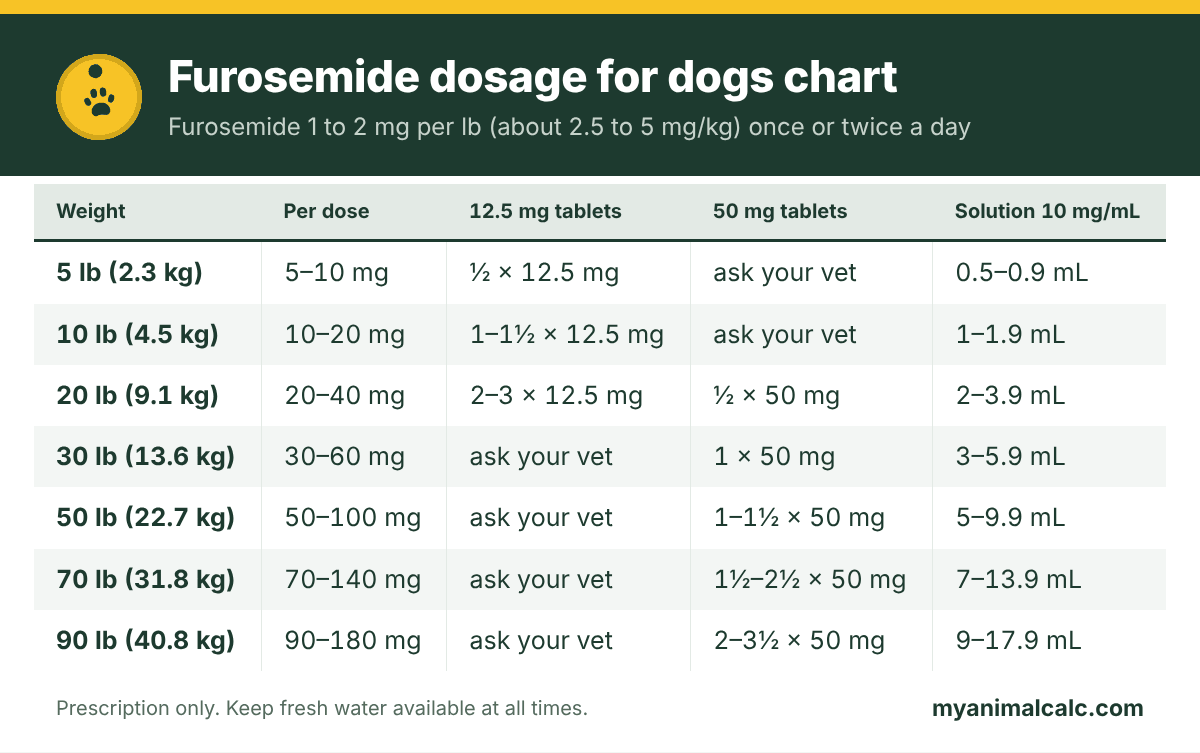
For heart disease, see also the Vetmedin dosage for dogs calculator and the benazepril dosage for dogs calculator, and track breathing with the dog breathing rate calculator.
Furosemide dosage for dogs FAQs
How much furosemide do I give my dog?
The label dose is 1 to 2 mg per pound once or twice a day. A 25 lb dog gets 25 to 50 mg a dose, which is half to one 50 mg tablet. Heart patients often have a dose tailored by their vet.
Can furosemide be given twice a day?
Yes. The label allows once or twice a day with 6 to 8 hours between doses; in heart failure, vets sometimes give it more often.
Why is my dog peeing so much on furosemide?
That is how it works. It makes the kidneys remove extra water, so your dog will drink and pee more. Keep water available at all times.
Is Lasix the same as Salix?
Both are brand names for furosemide: Lasix for people and Salix for animals. The drug is the same, but the tablet strengths differ.
What happens if a dog gets too much furosemide?
It can become dehydrated, with low potassium and sodium. Signs include weakness, vomiting and wobbliness. Call your vet promptly.
Can I stop furosemide if my dog seems better?
Not without your vet. In heart failure the fluid usually comes back when it is stopped, so ask before changing the dose.