| Normal asleep or at rest | Under 30 breaths a minute |
|---|---|
| Healthy dogs asleep | About 13 a minute on average |
| Call your vet | If it stays above 30 at rest, or keeps rising |
| Emergency | Hard breathing, blue or pale gums, collapse |
| How to count | Breaths in 30 seconds × 2 |
How to use the dog breathing rate calculator
- Wait until your dog is sound asleep or lying calmly, at least 15 minutes after exercise, and not panting or dreaming.
- Count each rise and fall of the chest as one breath for 30 seconds (or 15 or 60).
- Enter the count and the time, whether your dog was asleep or awake, and its usual rate if you know it.
- Read the breaths per minute and whether the rate is normal, raised or a reason to call your vet.
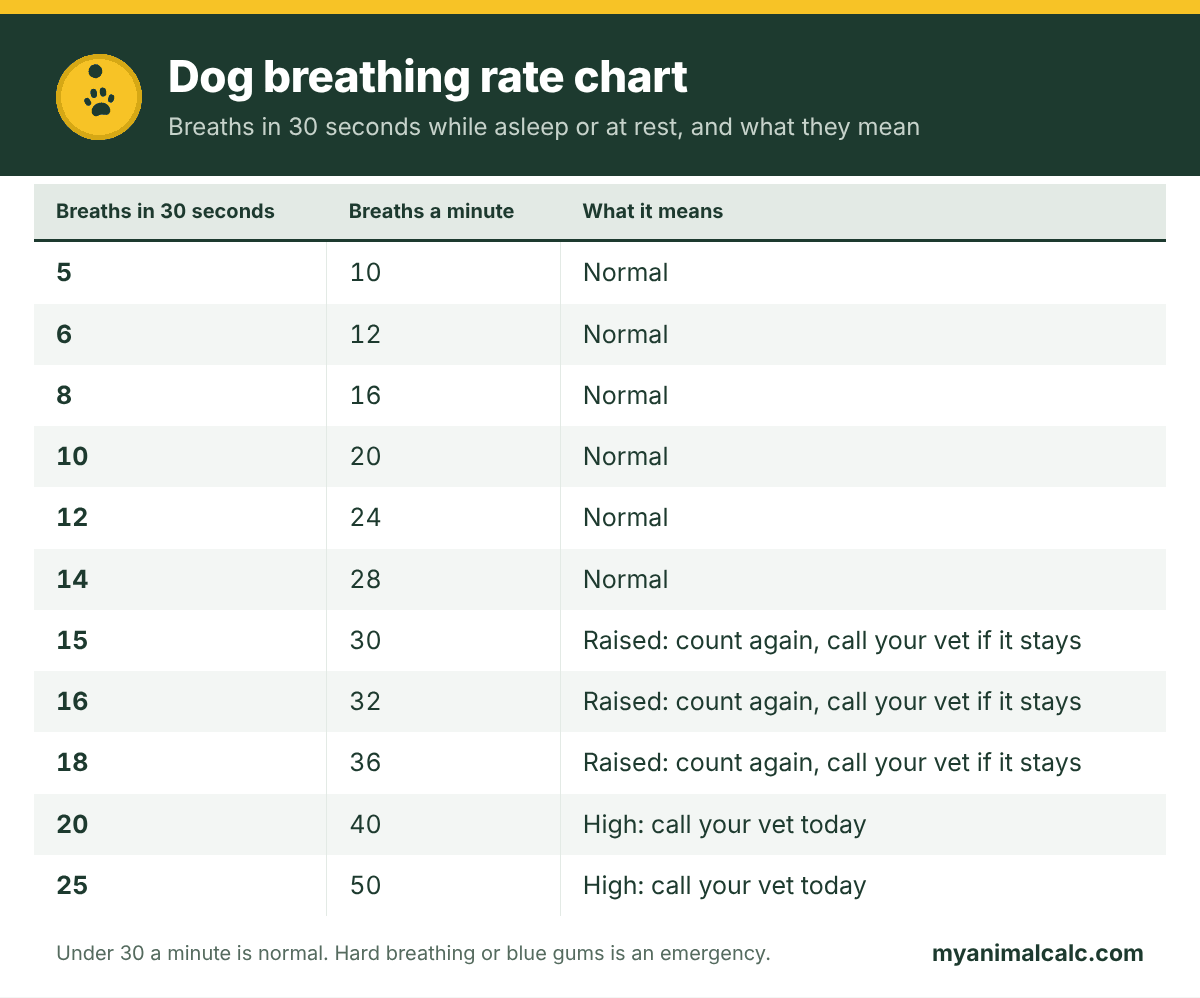
Dog breathing rate chart
Breaths counted in 30 seconds while asleep or resting quietly, and what the rate per minute means.
| Breaths in 30 seconds | Breaths a minute | What it means |
|---|---|---|
| 5 | 10 | Normal |
| 6 | 12 | Normal |
| 8 | 16 | Normal |
| 10 | 20 | Normal |
| 12 | 24 | Normal |
| 14 | 28 | Normal |
| 15 | 30 | Raised: count again, call your vet if it stays |
| 16 | 32 | Raised: count again, call your vet if it stays |
| 18 | 36 | Raised: count again, call your vet if it stays |
| 20 | 40 | High: call your vet today |
| 25 | 50 | High: call your vet today |
One high count is less worrying than a steady rise. Count once a day for a week to learn your dog’s normal, then keep a log.
Why the resting dog breathing rate matters
In dogs with heart disease, fluid builds up in the lungs as heart failure develops, and the breathing rate at rest rises before other signs appear. Healthy dogs rarely average more than 30 breaths a minute asleep, and most dogs whose heart failure is well controlled with medicine stay under 30 too. That is why cardiologists use 30 as the line: a dog that is consistently above it, or well above its own usual rate, should be checked. The calculator flags both.
How to count your dog’s breathing rate
Choose a time when your dog is deeply asleep or lying still and relaxed, in a cool room. Watch the chest or belly, or rest a hand lightly on the ribs, and count one breath each time it rises and falls. Use a phone timer for 30 seconds and double the count. Don’t count while your dog is panting, snoring or twitching in a dream, or within 15 minutes of exercise or excitement, because all of these raise the rate.
Fast breathing that is an emergency
Go to a vet now if your dog is working hard to breathe, with the belly pushing, nostrils flaring or open-mouth breathing at rest; if its gums or tongue look blue, grey or very pale; or if it collapses or cannot settle. Heavy panting after exercise in hot weather can be heatstroke: see the dog heatstroke risk calculator and cool your dog first.
Panting, sleeping and other normal changes
Panting is how dogs cool down and is not counted as breathing rate. Dogs breathe faster when awake than asleep, during dreams, when anxious or in pain, and in a warm room. Puppies breathe a little faster than adults. A slow rate, under 10 a minute, is common in deep sleep and usually nothing to worry about if your dog wakes normally.
Printable dog breathing rate chart
The chart above as an image, to save on your phone or print for the fridge. Use the calculator at the top of the page for your own dog.
Check a temperature with the dog temperature calculator. For heavy panting on a hot day, use the dog heatstroke risk calculator.
Dog breathing rate FAQs
What is a normal breathing rate for a dog?
Under 30 breaths a minute when asleep or resting quietly. Many healthy dogs breathe 10 to 25 times a minute while asleep.
How do I count my dog’s breaths per minute?
Count each rise and fall of the chest while your dog sleeps for 30 seconds, then multiply by 2. Or count for 15 seconds and multiply by 4.
Is 40 breaths per minute normal for a sleeping dog?
No. That is well above the normal sleeping rate of under 30. Call your vet today, and go in at once if the breathing looks hard or the gums are pale or blue.
Why is my dog breathing fast while sleeping?
Dreaming, a warm room, or recent exercise can do it. If the rate stays above 30 a minute when your dog is deeply asleep, heart or lung disease is possible and your vet should check.
Is panting the same as fast breathing?
No. Panting is fast, shallow, open-mouth breathing to cool down and is normal after exercise or in heat. Breathing rate is counted when your dog is calm and not panting.
How often should I count my dog’s breathing rate?
Daily for a week to learn its normal. Dogs with heart disease are often counted daily or a few times a week, as their vet advises.
Sources
- Texas A&M Veterinary Medical Teaching Hospital (Cardiac Education Group): Home breathing rate (PDF)
- Rishniw et al. (2012), Research in Veterinary Science: Sleeping respiratory rates in apparently healthy adult dogs
- Porciello et al. (2016), The Veterinary Journal: Sleeping and resting respiratory rates in dogs and cats with medically controlled heart failure
- Merck Veterinary Manual: Normal physiological values for dogs