| Main cause | Exercise, about 74% of cases in UK dogs; hot weather 13%; cars 5% |
|---|---|
| Highest risk | Flat-faced breeds, overweight dogs, older dogs, Chow Chows, Greyhounds and Bulldogs |
| Heat index bands | Caution from 80°F, extreme caution from 90°F, danger from 103°F (NWS) |
| Parked cars | About 40°F hotter inside within an hour, even on a 72°F day |
| First aid | Cool first with cool water, then drive to the vet |
How to use the dog heatstroke calculator
- Enter the air temperature in °F or °C and the relative humidity from your weather app.
- Choose sun or shade: the heat index assumes shade, and full sun makes it feel much hotter.
- Pick what your dog will be doing: resting, a normal walk, running or ball games, or waiting in a car.
- Tick any risk factors and read the risk level, the heat index and the advice for today.
Dog heatstroke risk chart by temperature and humidity
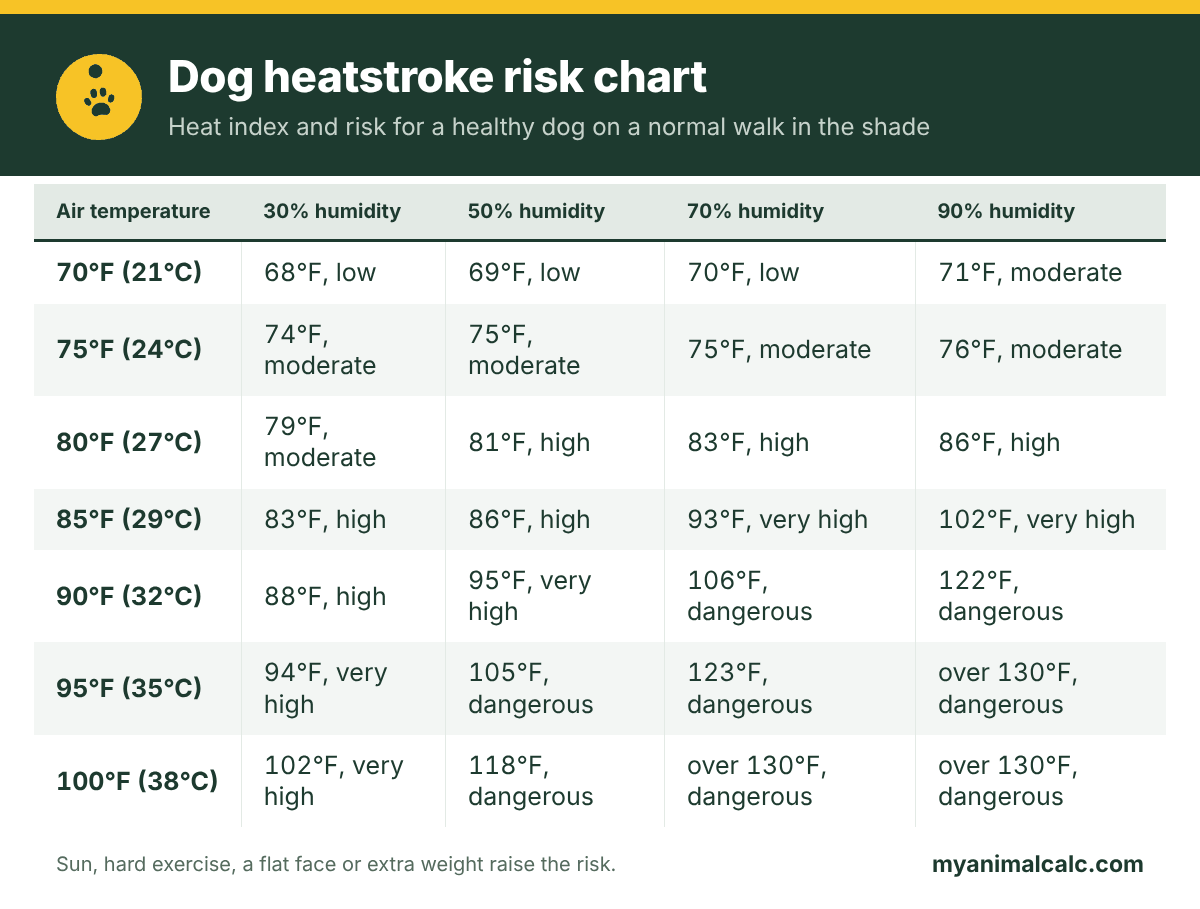
Heat index and risk level for a healthy dog on a normal walk in the shade. Sun, hard exercise and the risk factors move a dog one or two levels higher.
| Air temperature | 30% humidity | 50% humidity | 70% humidity | 90% humidity |
|---|---|---|---|---|
| 70°F (21°C) | 68°F, low | 69°F, low | 70°F, low | 71°F, moderate |
| 75°F (24°C) | 74°F, moderate | 75°F, moderate | 75°F, moderate | 76°F, moderate |
| 80°F (27°C) | 79°F, moderate | 81°F, high | 83°F, high | 86°F, high |
| 85°F (29°C) | 83°F, high | 86°F, high | 93°F, very high | 102°F, very high |
| 90°F (32°C) | 88°F, high | 95°F, very high | 106°F, dangerous | 122°F, dangerous |
| 95°F (35°C) | 94°F, very high | 105°F, dangerous | 123°F, dangerous | over 130°F, dangerous |
| 100°F (38°C) | 102°F, very high | 118°F, dangerous | over 130°F, dangerous | over 130°F, dangerous |
Humidity matters as much as heat: 85°F at 70% humidity feels like 93°F. Flat-faced dogs, and any dog running or playing hard, can be at high risk from about 75°F.
Which dogs are most at risk of heatstroke
In a study of more than 900,000 dogs under UK vet care, flat-faced (brachycephalic) breeds had higher odds of every type of heat-related illness. Chow Chows, Bulldogs, French Bulldogs, Greyhounds, English Springer Spaniels, Cavalier King Charles Spaniels and Staffordshire Bull Terriers were among the breeds most often affected by exercise-related heatstroke. Overweight dogs are at higher risk, and older dogs and dogs with heart or breathing problems struggle in hot weather even at rest. Most cases happened from May to August.
Signs of dog heatstroke
Vets now grade heat-related illness in three steps. Mild: heavy panting that doesn’t ease with rest, tiredness and reluctance to move. Moderate: vomiting, diarrhea, wobbling, collapse or a single seizure. Severe: confusion, repeated seizures, bleeding and organ damage. Acting at the mild stage saves lives: in UK practices 97% of dogs with mild heat-related illness survived, against 43% of dogs with the severe form.
First aid, cool first and transport second
If your dog shows signs of heatstroke, start cooling it straight away, before you set off for the vet. Move it into shade and pour cool or cold water all over it, or stand it in a paddling pool or stream, and let a fan or breeze blow over it. Then drive to the vet with the air conditioning on and call ahead. Use the dog temperature calculator if you can take its temperature; above 104°F (40°C) is an emergency.
Hot cars, pavements and safer walks
Never leave a dog in a parked car. On sunny days of 72 to 96°F, a Stanford study found the inside of a car warmed by about 40°F within an hour, with most of the rise in the first 30 minutes, and cracking the windows made no real difference. On hot days walk early in the morning or late in the evening, keep to shade and grass and carry water. Test the pavement with the back of your hand: if it is too hot to hold it there, it is too hot for paws.
Printable dog heatstroke chart
The chart above as an image, to save on your phone or print for the fridge. Use the calculator at the top of the page for your own dog.
After a hot day out, check your dog with the dog temperature calculator and the dog dehydration calculator, and see how much it should drink on the dog water intake calculator.
Dog heatstroke FAQs
What temperature is too hot to walk a dog?
There is no single number, because humidity, sun and the dog matter. As a rule, a heat index from 80°F calls for short, slow walks early or late in the day, and from 90°F only short toilet walks in the shade. Flat-faced and overweight dogs are at risk at lower temperatures.
Is 80 degrees too hot for a dog?
At 80°F the heat index is about 79 to 86°F depending on humidity, at or just inside the US weather service’s caution band. Most healthy dogs can manage a short walk in the shade early or late in the day; skip running and ball games, and keep flat-faced dogs indoors.
What causes heatstroke in dogs?
Mostly exercise. In UK vet records about 74% of cases followed exercise, 13% were caused by hot weather alone and 5% by hot cars. Dogs can overheat on a walk even on a day that feels only warm to people.
How do I cool down an overheated dog?
Cool first, transport second. Move your dog into shade, pour cool or cold water over it or stand it in water, use a fan, then drive to the vet with the air conditioning on. Don’t wait for signs to get worse.
Is it safe to leave a dog in the car with the windows down?
No. Cracking the windows hardly slows the heating: a car on a sunny 72°F day can reach 117°F inside within an hour.
Which breeds overheat most easily?
Flat-faced breeds such as Bulldogs, French Bulldogs and Pugs, plus Chow Chows, Greyhounds, English Springer Spaniels, Cavalier King Charles Spaniels and Staffordshire Bull Terriers in UK data. Overweight and older dogs are at higher risk too.
Sources
- Hall, Carter and O’Neill (2020), Animals: Dogs don’t die just in hot cars, exertional heat-related illness in UK dogs
- Hall et al. (2021), Scientific Reports: Proposing the VetCompass clinical grading tool for heat-related illness in dogs
- Royal Veterinary College: Owners of hot dogs should “cool first, transport second”
- US National Weather Service: The heat index equation
- McLaren, Null and Quinn (2005), Pediatrics: Heat stress from enclosed vehicles
- American Kennel Club: How hot is too hot for a dog’s paws?