For puppies under 6 months, growth differs too much between breeds to predict reliably from weight alone, so the calculator uses the parents’ adult weights instead.
| Small (up to 20 lb) | 75% grown at 6 months; done by about 12 |
|---|---|
| Medium (21 to 50 lb) | 66% at 6 months; done by about 15 |
| Large (51 to 100 lb) | 60% at 6 months; done by about 18 |
| Extra large (over 100 lb) | 50% at 6 months; done by about 18 |
| Under 6 months | Use the parents’ weights |
| Growth charts | Your vet can plot weight from 12 weeks |
How to use the puppy weight calculator
- Choose Weight now for a puppy of 6 to 18 months, or Parents for a younger puppy.
- Enter the weight in pounds or kilograms, and the age in months.
- Read the estimated adult weight and the size group it puts your puppy in.
- Check the expected weights at 6, 9, 12, 15 and 18 months to follow its growth.
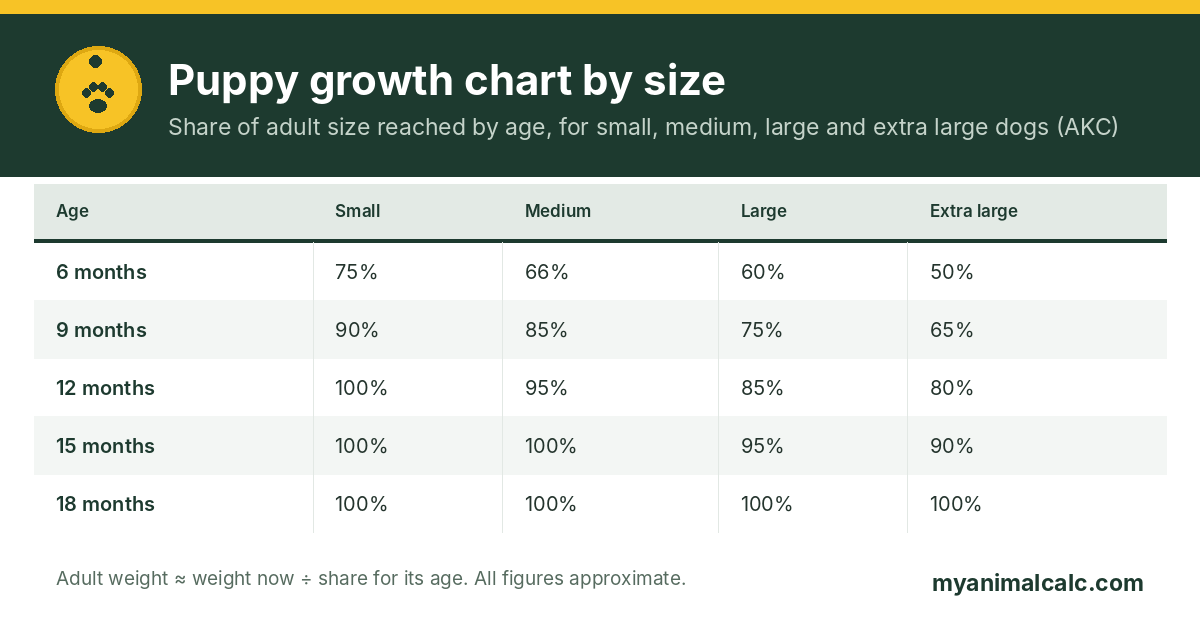
Puppy growth chart by size
Share of adult size reached at each age, from the American Kennel Club; all figures are approximate.
| Age | Small | Medium | Large | Extra large |
|---|---|---|---|---|
| 6 months | 75% | 66% | 60% | 50% |
| 9 months | 90% | 85% | 75% | 65% |
| 12 months | 100% | 95% | 85% | 80% |
| 15 months | 100% | 100% | 95% | 90% |
| 18 months | 100% | 100% | 100% | 100% |
The puppy weight calculator above divides your puppy’s weight by the share for its age and size.
How big will my puppy get?
Divide today’s weight by the share of adult size reached at that age. A 36 lb puppy at 6 months works out at about 60 lb as a large dog (36 ÷ 0.60), and the calculator picks the large group because 60 lb falls in its 51 to 100 lb range. The AKC notes that its figures are approximate, that small breeds typically stop growing at about 6 to 8 months, and that dogs keep adding muscle and some fat after their bones stop growing.
The parents are the best guide for a young puppy: a purebred puppy usually ends up close to the size of its parents in good body condition, which is also how veterinary growth charts estimate adult size.
Why young puppies are hard to predict
Research by Salt and colleagues on more than six million dogs found very small breeds reach adult weight at 8 to 12 months, while larger breeds can take up to 24 months, so growth curves fan out widely. Their growth standard charts, now used by vets as the WALTHAM puppy growth charts, start at 12 weeks and come in five bands by expected adult weight, up to 40 kg. The AKC adds that guessing the final size of a mixed-breed puppy is especially hard between 6 and 10 weeks.
Tracking growth with your vet
- Weigh your puppy every few weeks on the same scale and keep a record.
- Ask your vet to plot it on a puppy growth chart for its size and sex.
- Check body condition as well as weight; the dog BMI calculator shows how.
- Feed a growth diet in the amount recommended for its expected adult size.
Printable puppy growth chart
The chart above as an image, to save on your phone or print. Use the puppy weight calculator at the top of the page for any other date.
Feed for that adult size with the puppy feeding calculator. For newborns, use the newborn puppy weight gain calculator, and for a dog’s age the dog years to human years calculator.
Puppy weight calculator FAQs
How do I estimate my puppy’s adult weight?
Divide its weight by the share of adult size it has reached for its age and size group; at 6 months that is about 75% for small dogs and 50% for extra large dogs, according to the AKC.
At what age is a dog fully grown?
Small dogs at about 12 months, medium dogs at about 15 and large and giant dogs at about 18 months, though some giant breeds keep filling out to 24 months.
Can I predict the adult weight of an 8 week old puppy?
Only roughly. At that age the parents’ adult weights are a better guide than the puppy’s own weight.
Is my puppy overweight?
Check its body condition, not just the scale: you should feel the ribs easily and see a waist. Ask your vet if you are unsure.