| Senior from | The last 25% of life: about 7 to 10 years, by size |
|---|---|
| Healthy senior | 95 to 105 kcal × ideal kg^0.75 a day |
| Less active senior | About 1.2 × RER |
| Protein | At least 7 g per 100 kcal, about 25% of calories |
| Weigh | Every 2 to 4 weeks |
| Treats | Under 10% of the day’s calories |
How to use the senior dog food calculator calculator
- Enter your dog’s weight, age and body condition score (5 is ideal).
- Choose the adult size and how active your dog is now.
- Copy kcal per cup, kcal per kg and crude protein from the food label.
- Read the daily calories and cups, and whether the food has enough protein for an older dog.
Senior dog calories chart by ideal weight
Daily calories for senior dogs at their ideal weight, by activity, with the least protein suggested for the healthy figure.
| Ideal weight | Less active | Healthy | Very active | Protein (at least) |
|---|---|---|---|---|
| 10 lb (4.5 kg) | 260 kcal | 295 kcal | 325 kcal | 21 g |
| 20 lb (9.1 kg) | 440 kcal | 495 kcal | 550 kcal | 35 g |
| 30 lb (13.6 kg) | 595 kcal | 675 kcal | 745 kcal | 47 g |
| 40 lb (18.1 kg) | 740 kcal | 835 kcal | 925 kcal | 58 g |
| 50 lb (22.7 kg) | 875 kcal | 985 kcal | 1,090 kcal | 69 g |
| 60 lb (27.2 kg) | 1,000 kcal | 1,130 kcal | 1,250 kcal | 79 g |
| 80 lb (36.3 kg) | 1,240 kcal | 1,405 kcal | 1,550 kcal | 98 g |
| 100 lb (45.4 kg) | 1,470 kcal | 1,660 kcal | 1,835 kcal | 116 g |
Energy needs vary a lot between individual dogs, so treat these as starting points. The senior dog food calculator above turns them into cups of your own food.
How many calories does a senior dog need?
The AAHA senior care guidelines note that a dog’s energy needs generally fall over its lifetime, as muscle and activity decline. A common estimate for healthy older dogs is 95 to 105 kcal per kg^0.75 a day, though individual dogs vary by as much as 50% either way. For a 40 lb (18 kg) senior at ideal weight that is about 835 to 925 kcal, or about 740 kcal if it is less active. Overweight seniors are fed for their ideal weight instead.
Do older dogs need less protein?
No. A review by Dorothy Laflamme found that protein needs rise by about 50% in older dogs while their calorie needs fall, and that cutting protein in healthy older dogs is unnecessary and can speed the loss of muscle. She suggests at least 25% of calories from protein, which is about 7 g of protein per 100 kcal. The senior dog food calculator works this out from the crude protein % and kcal per kg on the label. Dogs with kidney disease are the exception: they need a vet diet.
When is a dog a senior?
The AAHA life stage guidelines define a senior dog as one in the last 25% of its expected lifespan, so big dogs become seniors sooner. That is about 7 years for giant breeds, 8 for large, 9 for medium and 10 for small dogs. AAHA also points out that AAFCO has no nutrient profile for seniors, so foods labelled senior vary widely; senior dogs generally do best on food with fewer calories per cup, a little more fiber and good-quality protein.
Printable senior dog calories chart
The chart above as an image, to save on your phone or print. Use the calculator at the top of the page for your own dog.
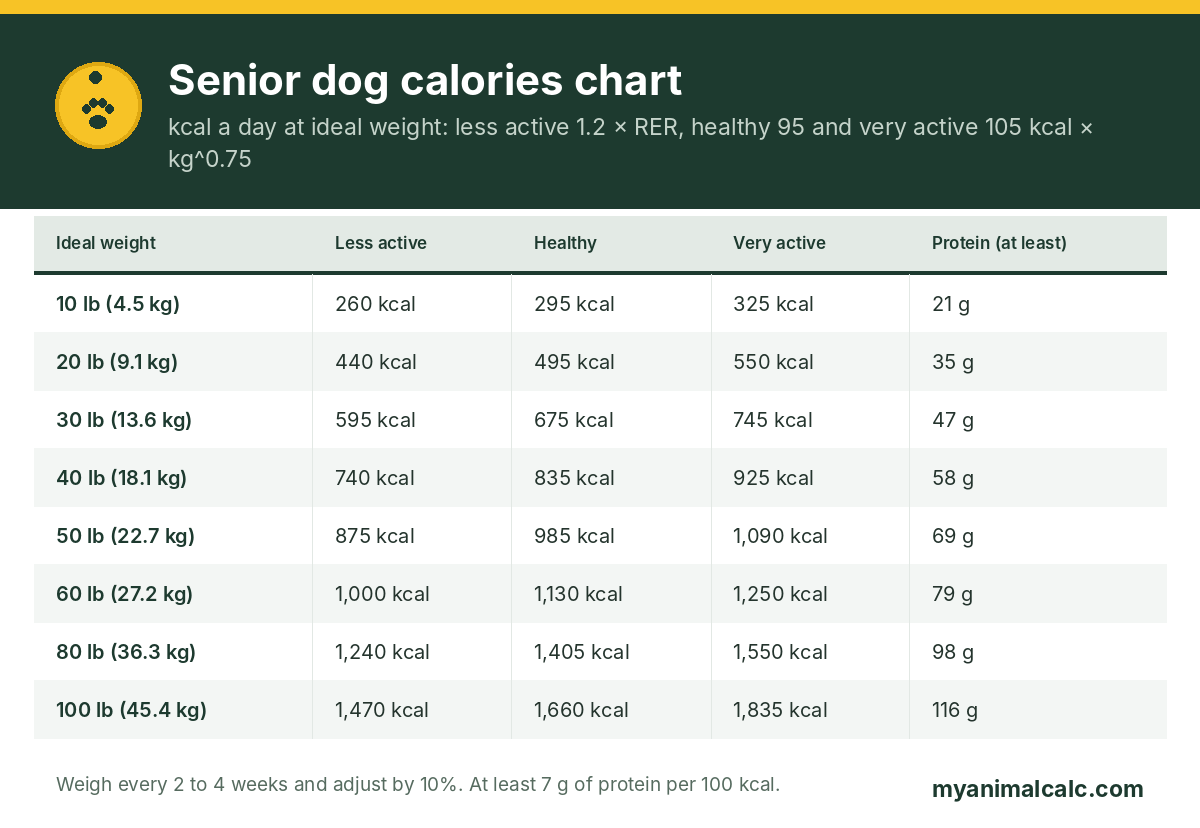
For younger adults, use the dog calorie calculator. Overweight seniors can follow the dog weight loss calculator, and the dog protein calculator shows protein needs in more detail.
Senior dog food calculator FAQs
How much should I feed my senior dog?
Start from its ideal weight: about 95 kcal × kg^0.75 a day for a healthy senior, or 1.2 × RER if it is less active. A 40 lb (18 kg) senior needs about 835 kcal, or 740 kcal if less active.
Do senior dogs need senior dog food?
Not necessarily. There is no AAFCO senior profile, so choose a complete and balanced food that keeps your dog at a lean body condition and gives at least 7 g of protein per 100 kcal.
Should older dogs eat less protein?
Healthy older dogs need more protein, not less. Lower-protein diets are for dogs with kidney disease, on your vet’s advice.
At what age is a dog a senior?
In the last 25% of its expected lifespan: about 7 years for giant breeds, 8 for large, 9 for medium and 10 for small dogs.