| After 10 minutes | About 19°F (11°C) hotter than outside |
|---|---|
| After 30 minutes | About 34°F (19°C) hotter |
| After 60 minutes | About 43°F (24°C) hotter |
| Cracked windows | Almost no difference |
| A 72°F day | The car reached 117°F within an hour |
| Safe time for a dog | None; take your dog with you or leave it at home |
How to use the dog hot car temperature calculator
- Enter the temperature outside, in °F or °C.
- Enter how many minutes the car would be parked, up to 60.
- Choose closed or cracked windows to see why cracking them doesn’t help.
- Read the temperature inside, the minute-by-minute table and what to do if you see a dog in a hot car.
Hot car temperature chart for dogs
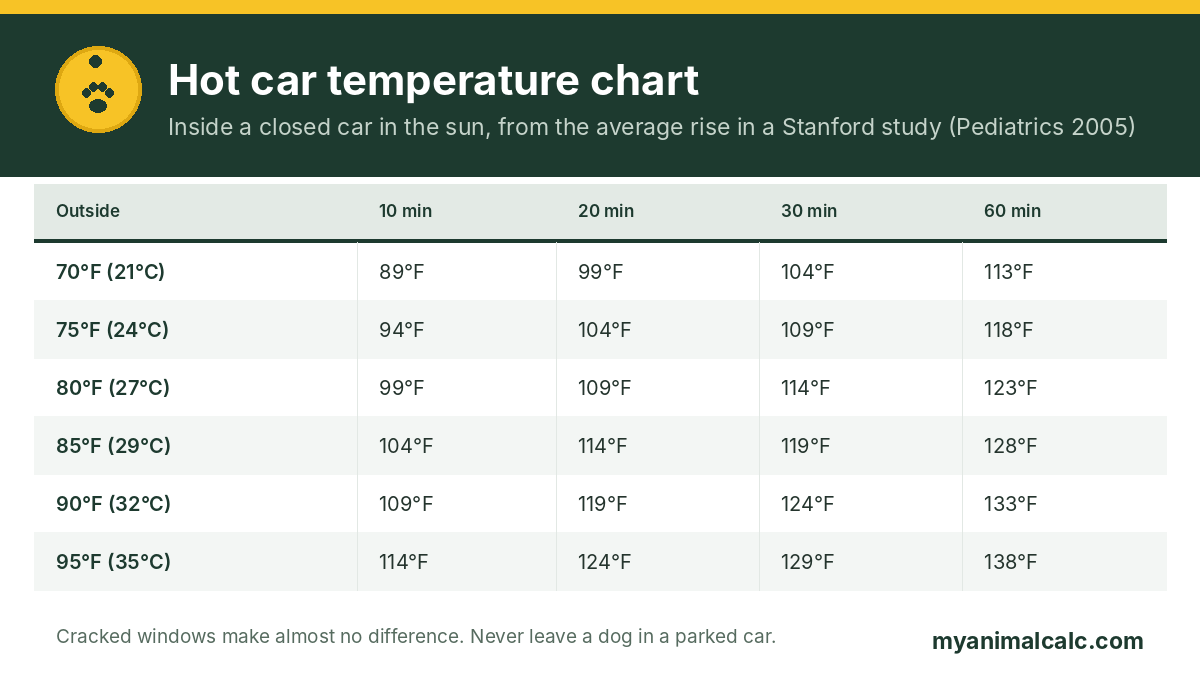
Inside air temperature of a closed car in the sun, from the average rise measured in the study, at common outside temperatures.
| Outside | After 10 min | After 20 min | After 30 min | After 60 min |
|---|---|---|---|---|
| 70°F (21°C) | 89°F | 99°F | 104°F | 113°F |
| 75°F (24°C) | 94°F | 104°F | 109°F | 118°F |
| 80°F (27°C) | 99°F | 109°F | 114°F | 123°F |
| 85°F (29°C) | 104°F | 114°F | 119°F | 128°F |
| 90°F (32°C) | 109°F | 119°F | 124°F | 133°F |
| 95°F (35°C) | 114°F | 124°F | 129°F | 138°F |
Seats, the dashboard and the steering wheel get far hotter than the air. Most of the rise happens in the first 15 to 30 minutes.
What the hot car study found
Researchers at Stanford measured the air inside a dark mid-size sedan on 16 clear days between May and August, with outside temperatures from 72 to 96°F. The rate of warming was about the same whatever the outside temperature, an average of 3.2°F every 5 minutes, and 80% of the rise came in the first 30 minutes. Cracking the windows open made no meaningful difference to the rate or the final temperature.
Why hot cars are so dangerous for dogs
Dogs cool themselves mainly by panting, which works poorly in hot, still, humid air. A dog shut in a car breathes out moisture, making the air more humid as it heats. Flat-faced breeds, overweight, old and thick-coated dogs, and dogs with heart or breathing problems overheat fastest. Heatstroke can damage the brain, kidneys and gut and can kill within hours.
Signs of heatstroke are heavy panting that won’t settle, thick drool, bright red or dark gums, vomiting, diarrhea, wobbling, collapse and seizures. Cool the dog with cool (not ice-cold) water, then drive to a vet with the air conditioning on.
If you see a dog in a hot car
- Note the car’s make, model, color and license plate.
- Ask nearby shops or businesses to page the owner.
- Call local animal control or the non-emergency police line; call 911 if the dog looks distressed.
- Stay with the car until help arrives. Some states let bystanders act, but rules differ, so follow what officials tell you.
Printable hot car temperature chart
The chart above as an image, to save on your phone or print. Use the calculator at the top of the page for your own dog.
Check today’s walk with the dog heatstroke risk calculator, take your dog’s temperature with the dog temperature calculator, and keep water handy with the dog water intake calculator.
Dog hot car temperature FAQs
How hot does a car get on a 70 degree day?
In the study, a closed car warmed by about 19°F in 10 minutes and 43°F in an hour, so a 70°F day can mean about 89°F after 10 minutes and over 110°F after an hour in the sun.
Is it OK to leave a dog in the car with the windows cracked?
No. Cracking the windows made almost no difference to how fast the car heated up or how hot it got.
How long can a dog stay in a hot car?
There is no safe time on a warm, sunny day. The temperature climbs fastest in the first 10 to 20 minutes.
What about leaving the engine and air conditioning running?
Air conditioning can fail or switch off, and a car warms quickly once it does. The safest choice is to take your dog with you or leave it at home.