| Naphthalene | Anemia from about 1.5 g/kg; vomiting at lower doses |
|---|---|
| Paradichlorobenzene | Less toxic; dogs given 1.5 g/kg showed no signs |
| Camphor | The most toxic; seizures possible; any amount needs a vet |
| One mothball | About 2.7 to 5 g |
| Telling them apart | In salty water, naphthalene floats and PDB sinks |
| What to do | Call your vet or a poison line now |
How to use the dog mothball toxicity calculator
- Enter your dog’s weight.
- Enter how many mothballs are missing, or the grams of flakes or crystals.
- Choose the type from the package, or do the salt-water test below. If you don’t know, leave it on “not sure”, which counts as naphthalene.
- Read the dose in g/kg and the risk, then call your vet or a poison line.
How many mothballs are toxic to dogs (chart by weight)
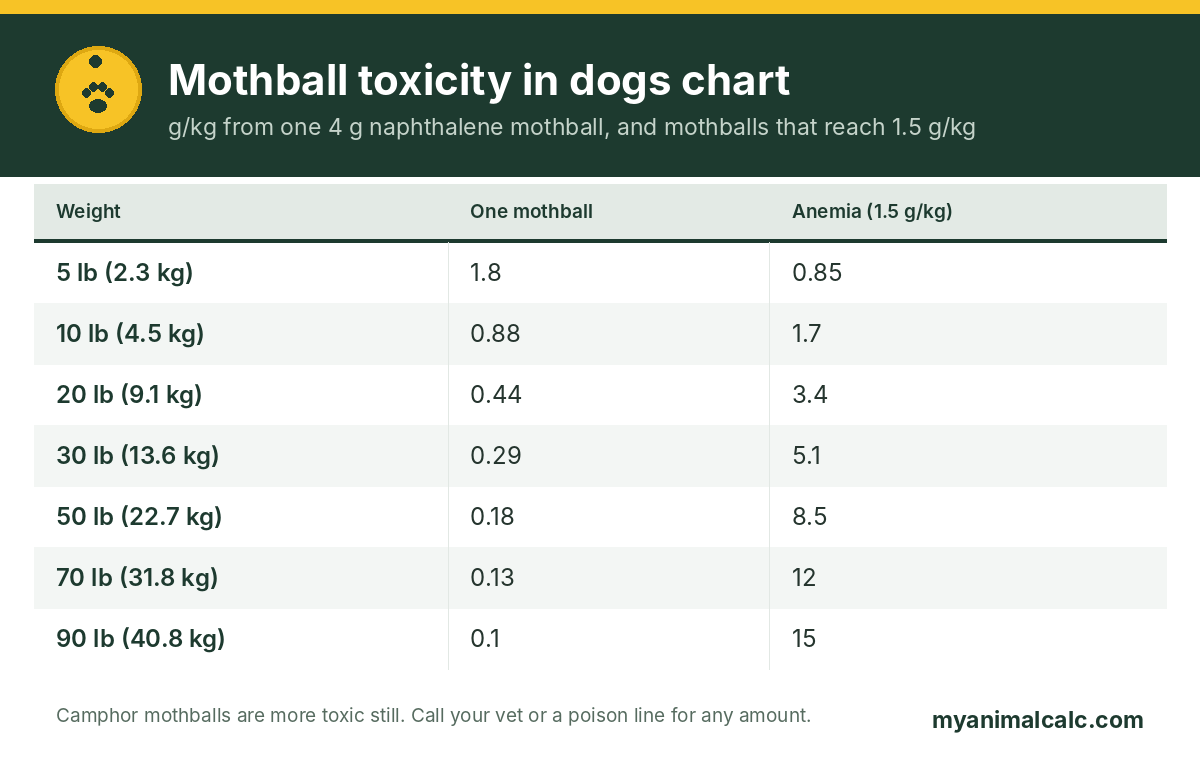
The dose from one 4 g naphthalene mothball, and the number of mothballs that reach 1.5 g/kg, for dogs of common weights.
| Dog’s weight | One mothball (g/kg) | Anemia level (mothballs) |
|---|---|---|
| 5 lb (2.3 kg) | 1.8 | 0.85 |
| 10 lb (4.5 kg) | 0.88 | 1.7 |
| 20 lb (9.1 kg) | 0.44 | 3.4 |
| 30 lb (13.6 kg) | 0.29 | 5.1 |
| 50 lb (22.7 kg) | 0.18 | 8.5 |
| 70 lb (31.8 kg) | 0.13 | 12 |
| 90 lb (40.8 kg) | 0.1 | 15 |
Lower doses still cause vomiting and stomach irritation, and repeated small doses can add up. Any mothball is a reason to call.
How to tell what kind of mothball your dog ate
The package usually lists the active ingredient. If not, the MSD Veterinary Manual describes a simple test: dissolve 3 tablespoons of salt in half a cup (125 mL) of warm water and drop in a spare mothball. Naphthalene floats; paradichlorobenzene sinks. Camphor mothballs float even in plain water. On an X-ray, PDB mothballs show up clearly while naphthalene ones are faint.
Symptoms of mothball poisoning in dogs
Vomiting, drooling, a mothball smell on the breath, belly pain and poor appetite usually come first. Naphthalene can then damage red blood cells over the next few days, causing weakness, pale or brown gums, fast breathing and dark urine. Camphor can cause tremors and seizures within minutes to hours. Paradichlorobenzene usually causes milder stomach upset.
What to do if your dog ate mothballs
Call your vet or an animal poison line now: ASPCA (888) 426-4435 or Pet Poison Helpline (855) 764-7661 (a fee may apply). Bring the package or a spare mothball. Vets usually make the dog vomit, then give activated charcoal, which can still help many hours later because mothballs dissolve slowly. Blood tests over the next few days check for anemia. Keep mothballs in sealed containers out of reach, and never scatter them outdoors to repel animals.
Printable dog mothball toxicity chart
The chart above as an image, to save on your phone or print. Use the calculator at the top of the page for your own dog.
Other household poisons: the dog rat poison toxicity calculator, the dog antifreeze toxicity calculator and the dog salt toxicity calculator.
Dog mothball toxicity FAQs
How many mothballs are toxic to a dog?
For naphthalene, about 1.5 g per kg can cause anemia: roughly one 4 g mothball for a 6 lb dog, or six for a 35 lb dog. Smaller amounts still cause vomiting.
Are paradichlorobenzene mothballs safe for dogs?
They are less toxic than naphthalene, but they still cause stomach upset. Call your vet.
What if my dog only licked a mothball?
Licking usually causes drooling and mild stomach upset. Rinse the mouth with water and call your vet or a poison line for advice.
Can the smell of mothballs hurt my dog?
Breathing the fumes in a closed space can irritate the eyes and airways and, with naphthalene, add to the risk. Air the room and keep your dog out.