| Resting energy (RER) | 70 × weight in kg to the power 0.75 |
|---|---|
| Day 1 | 25 to 33% of RER |
| Day 2 | 50 to 67% of RER |
| Day 3 and 4 | 75 to 100%, then 100% of RER |
| High risk | Under 20% of RER on day 1, built up over 4 to 10 days |
How to use the dog refeeding calculator
- Enter your dog’s weight today, not the weight it used to be.
- Choose how long it went with little or no food and how thin it is.
- Pick the number of meals a day: 3 to 6 small meals are easier on the stomach.
- Add the kcal per cup or can from the food label to see the amount per meal.
Dog refeeding chart by weight
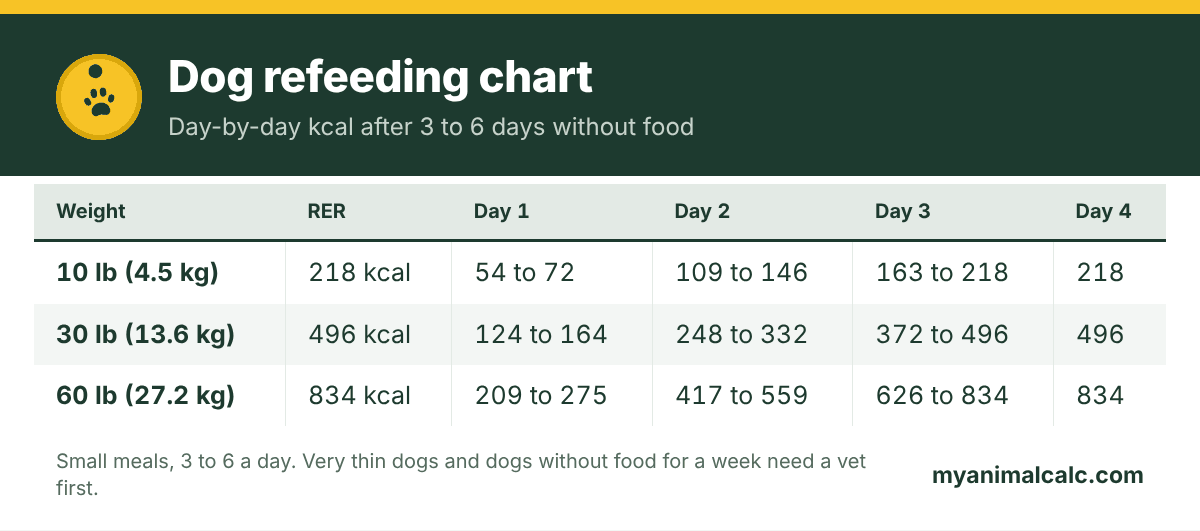
The standard plan after 3 to 6 days without food, in kcal a day, for three weights.
| Weight | RER | Day 1 | Day 2 | Day 3 | Day 4 |
|---|---|---|---|---|---|
| 10 lb (4.5 kg) | 218 kcal | 54 to 72 | 109 to 146 | 163 to 218 | 218 |
| 30 lb (13.6 kg) | 496 kcal | 124 to 164 | 248 to 332 | 372 to 496 | 496 |
| 60 lb (27.2 kg) | 834 kcal | 209 to 275 | 417 to 559 | 626 to 834 | 834 |
From day 4 your vet will move your dog up from RER towards its normal daily calories, as long as it eats without vomiting or diarrhea.
What is refeeding syndrome in dogs?
When a starved body gets food again, insulin rises and cells pull phosphorus, potassium and magnesium out of the blood. If the stores are already empty, blood levels can crash within the first days, causing weakness, breakdown of red blood cells, heart rhythm problems and seizures. It is rare, but most likely in emaciated dogs and dogs that haven’t eaten for a week or more. Starting at a small share of RER, and checking blood electrolytes, prevents most cases.
Dog refeeding plans compared
Veterinary sources agree on the principle and differ slightly on speed. In a Clinician’s Brief case, tube feeding started at a third of RER and was raised to two-thirds on day 2. ASPCApro’s protocol for emaciated dogs feeds a third, two-thirds, then all of RER of the intake weight, holds it for 7 days and only then moves up to the daily energy requirement. A 2022 review advises no more than 20% of RER on the first day for patients at risk, increased over 4 to 10 days, and case reports in emaciated dogs started as low as an eighth. For a 40 lb dog, RER is about 615 kcal, so day 1 is roughly 154 to 203 kcal.
Rescued and very thin dogs
A very thin dog needs a vet visit before refeeding: blood tests, deworming and a check for illnesses that caused the weight loss. Use the dog’s weight on the day, after it is rehydrated, not its ideal weight; ASPCApro estimates the ideal weight is often 20 to 30% higher, reached over weeks. Weigh it every few days. Once it is eating its full daily amount, the dog weight gain calculator plans the steady gain.
Printable dog refeeding chart
The chart above as an image, to save on your phone or print. Use the calculator at the top of the page for your own dog.
If your dog stopped eating because it is unwell, check the signs with the dog vomiting calculator and the dog dehydration calculator. For normal daily needs, use the dog calorie calculator.
Dog refeeding FAQs
How much should I feed a dog that hasn’t eaten in days?
Start with about a quarter to a third of its resting energy requirement on day 1, split into small meals, and build to the full amount over about 4 days.
How do you refeed a starving dog?
With a vet’s help: blood tests first, then about 20% of RER on day 1, increased over 4 to 10 days, in 4 to 6 small meals of a highly digestible food.
What are the signs of refeeding syndrome in dogs?
Weakness, wobbliness, fast breathing, dark urine, collapse or seizures in the first days of eating. Stop feeding and see a vet at once.
When should I worry about a dog not eating?
Call your vet if an adult dog skips food for more than a day with other signs, or for 2 days on its own; puppies and small dogs sooner.
What should I feed a dog after not eating?
A soft, highly digestible food, such as a vet recovery diet or your dog’s usual food softened with water, at room temperature.
Why use the dog’s current weight, not its ideal weight?
Feeding for the ideal weight too soon gives far more calories than a starved body can handle, which raises the risk of refeeding syndrome.
Sources
- Smith, Hendricks and Centola (2022), Veterinary Medicine: Research and Reports, refeeding syndrome case and review (Dove Press)
- Ontario Veterinary College Pet Nutrition: Stimulating appetite in dogs and cats, and refeeding
- ASPCApro: Feeding protocol and nutrition best practices for emaciated dogs
- Clinician’s Brief: Feeding the critically ill, anorectic dog
- Journal of the American Animal Hospital Association (2021): Refeeding syndrome in three emaciated dogs